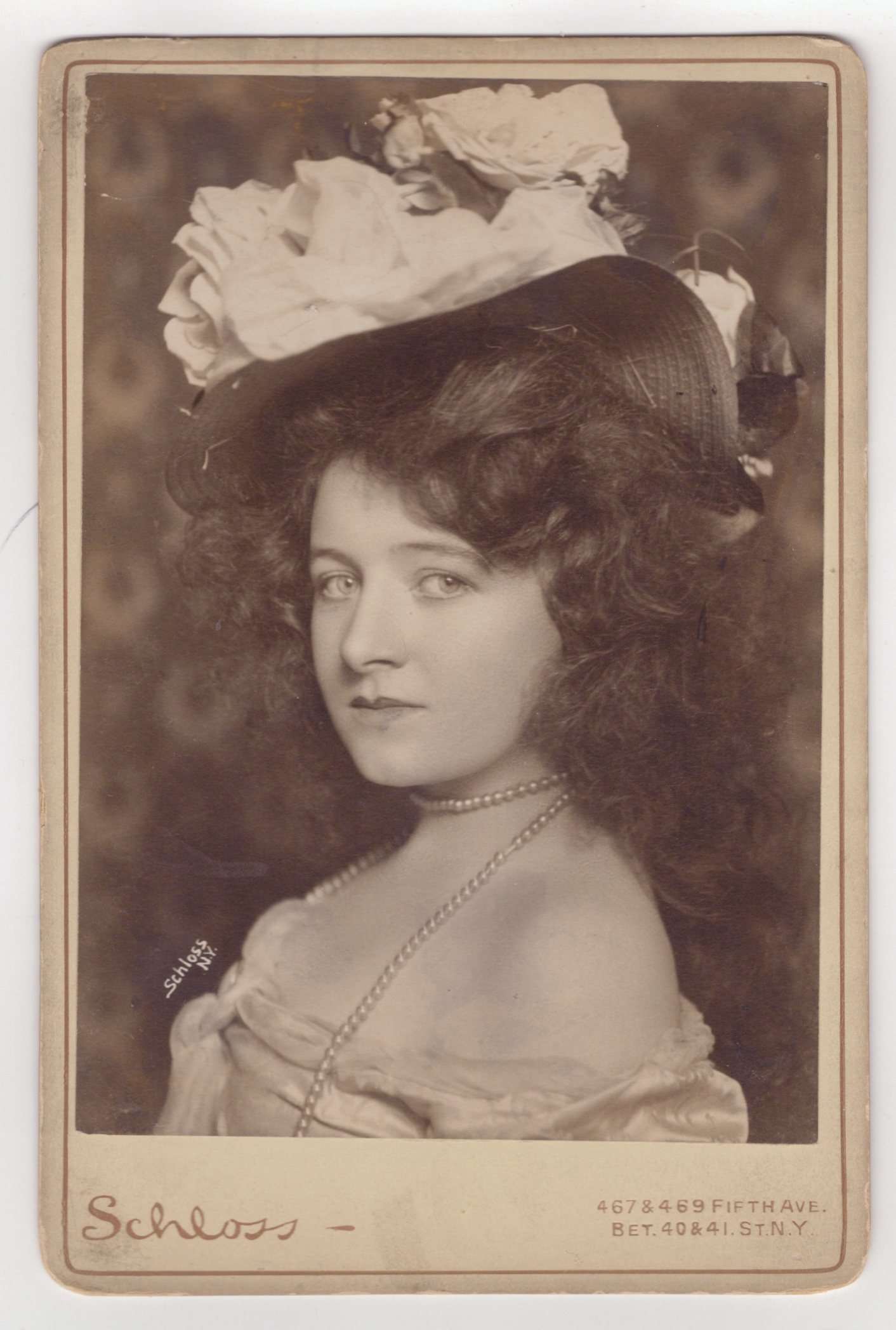
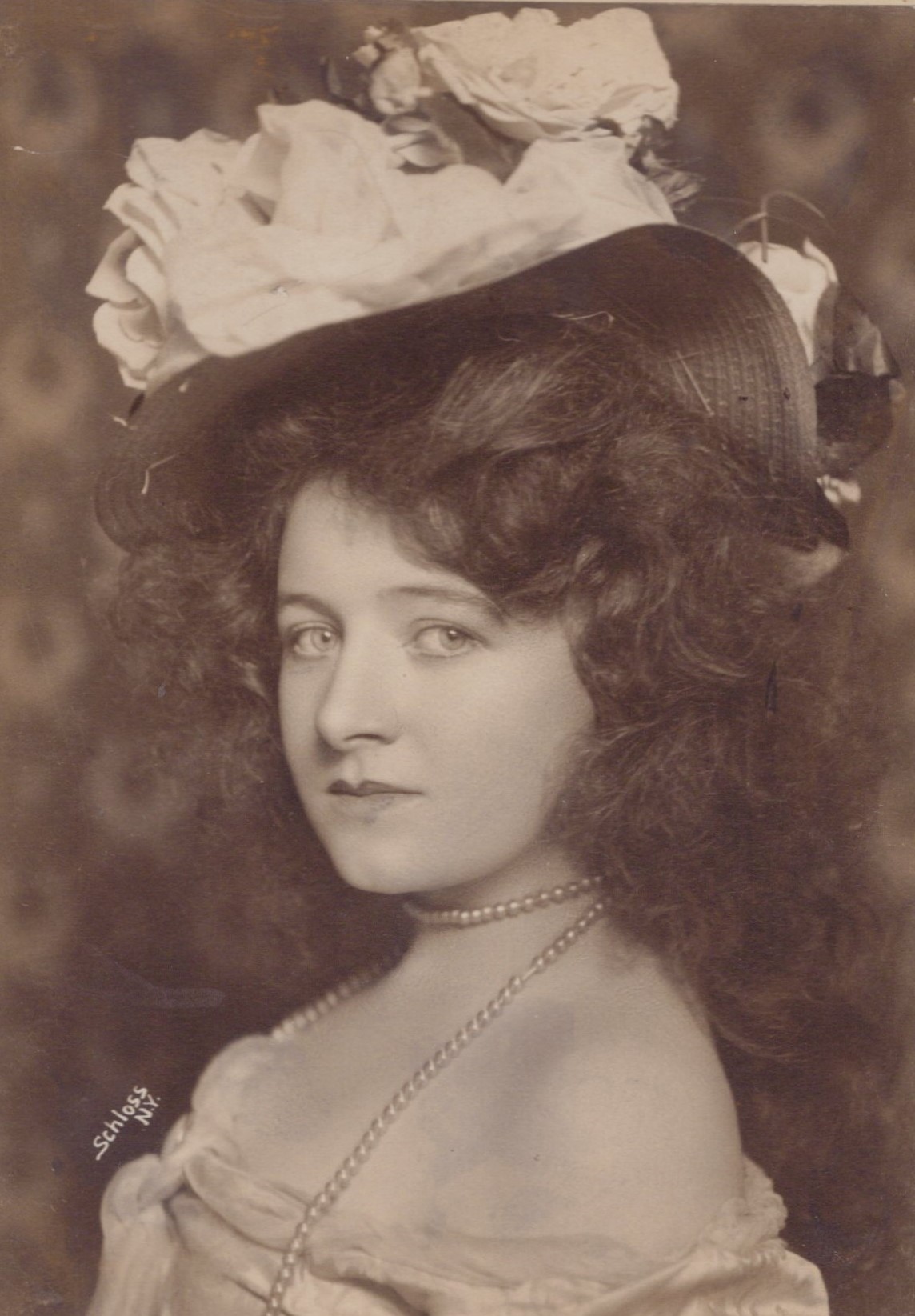
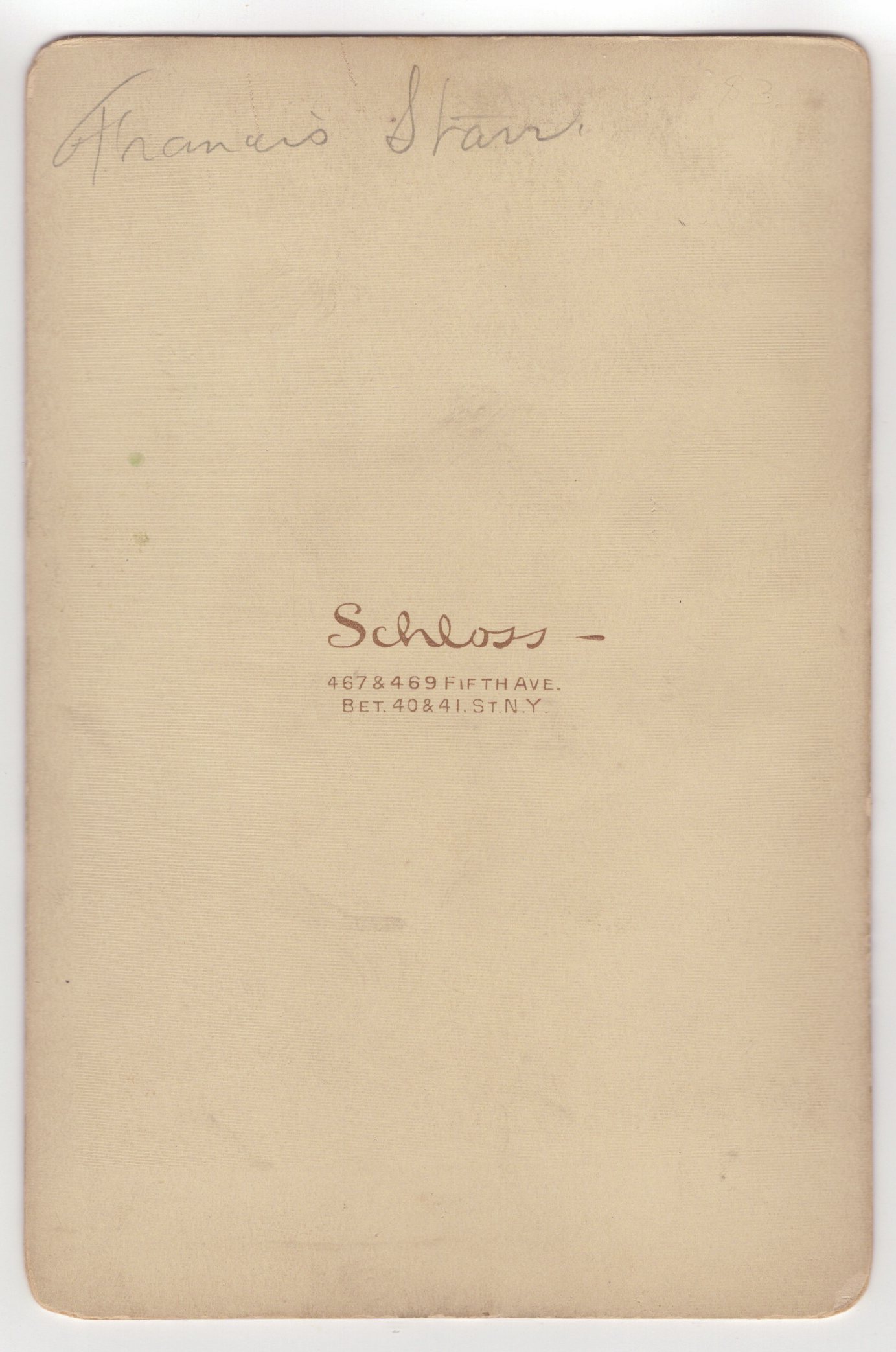
This cabinet card features stage, film and television actress, Frances Starr (1881-1973). The actress was photographed by Jacob Schloss of New York City, New York. Frances Grant Starr was an American stage, film and television actress. Her theatrical debut was in 1901 when she performed in an Albany (New York) stock company. In 1906, she appeared in New York City’s Garrick Theatre in “Gallops”. She then signed with David Belasco, a major theatrical producer, writer, impresario, and director. She worked for Belasco for the next 22 years. The role that propelled her to stardom was in “The Easiest Way” (1909). She had a long career in the theatre. The IMDb reports that she appeared in 26 Broadway plays from 1901 through 1953. Her longest run play was “Claudia” (1951). Starr appeared in one silent and three sound movies between 1923 and 1932. She also acted in 13 television series (!949-1958). Starr was married three times. One of her marriages was to the celebrated artist, William Haskell Coffin. He was an American painter and commercial artist. The photographer, Jacob Schloss was a well known New York City photographer who was famous for his portraits of theatrical stars. SOLD
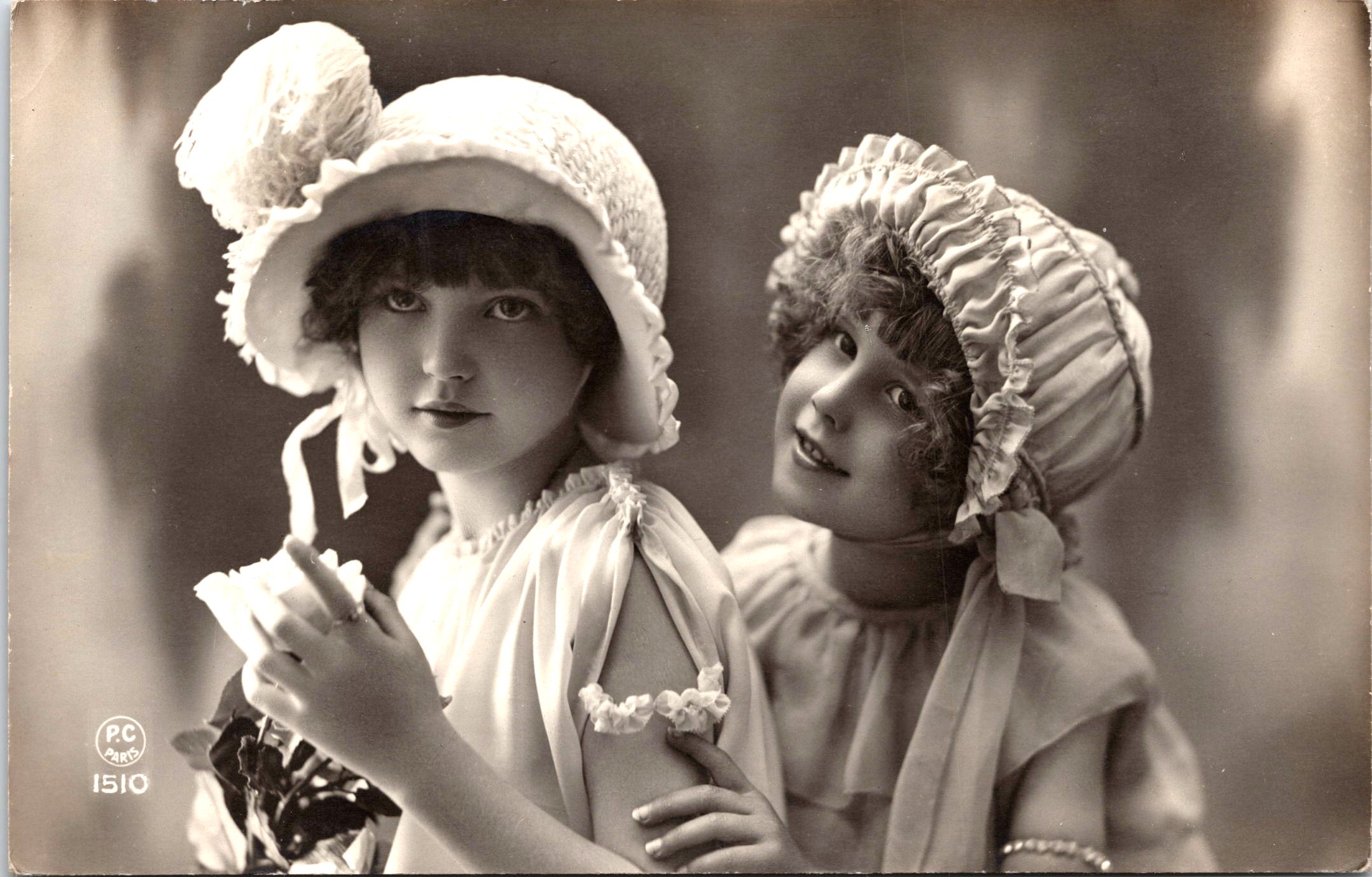
This vintage real photo postcard captures two very adorable and beautifully dressed little girls. They have magnificent smiles and sparkling eyes. This postcard was produced by PC Paris as part of a series (No.1510). The P.C logo is an abbreviation for Papeteries d Levallois-Clichy. The firm published a variety of real photo postcard topics including portraits of pretty models, nudes, views, and holiday cards. The company was active in the 1920’s. Here is the translation of the French message on the postcard: “Very Dear Cousin Agathe, On the occasion of your lovely name day,receive my best wishes and greetings, as well as those of my parents. I also send you my sweetest kisses to you and to all your family. Your little cousin, M. Soensur” (SOLD)
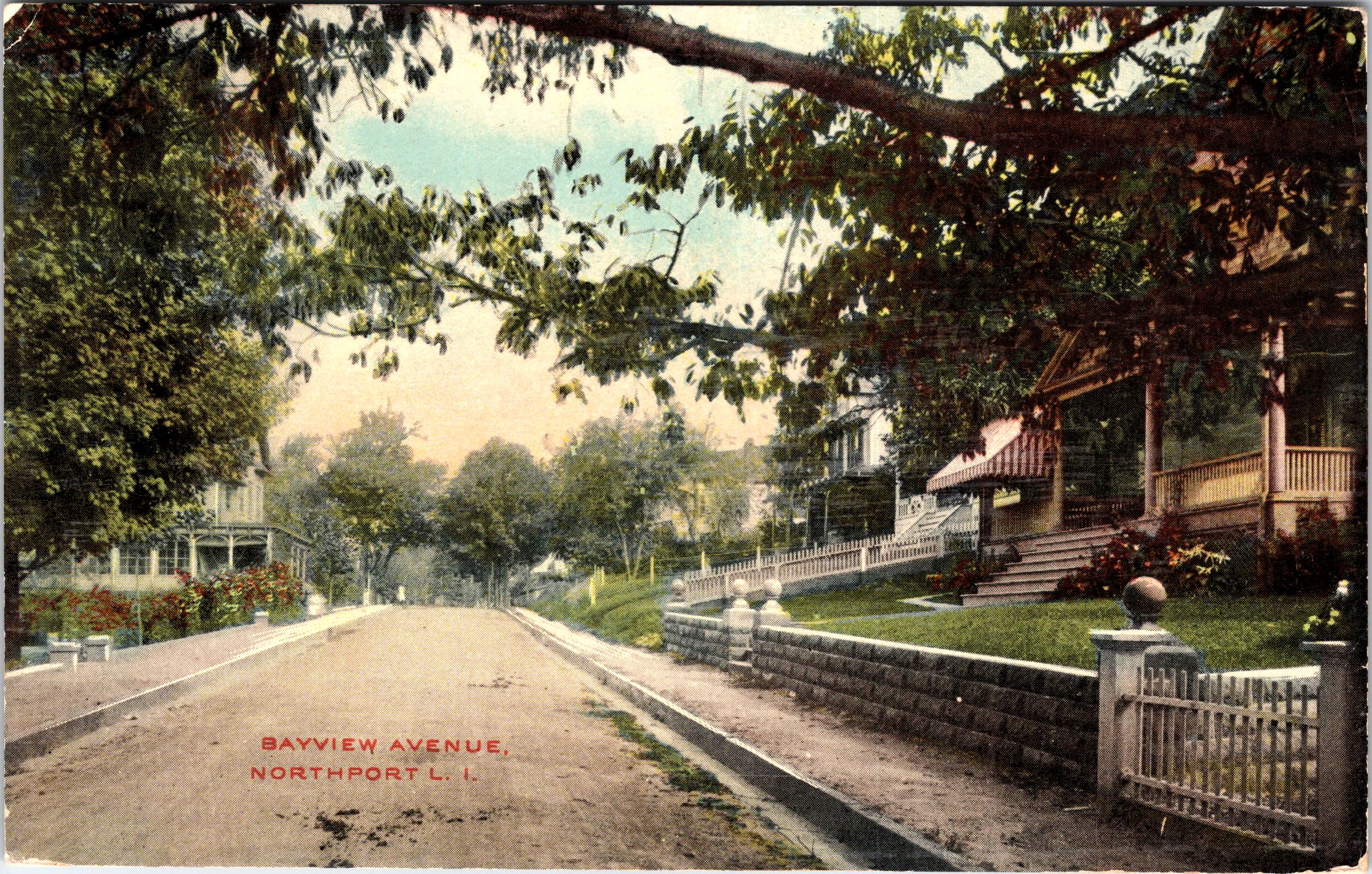
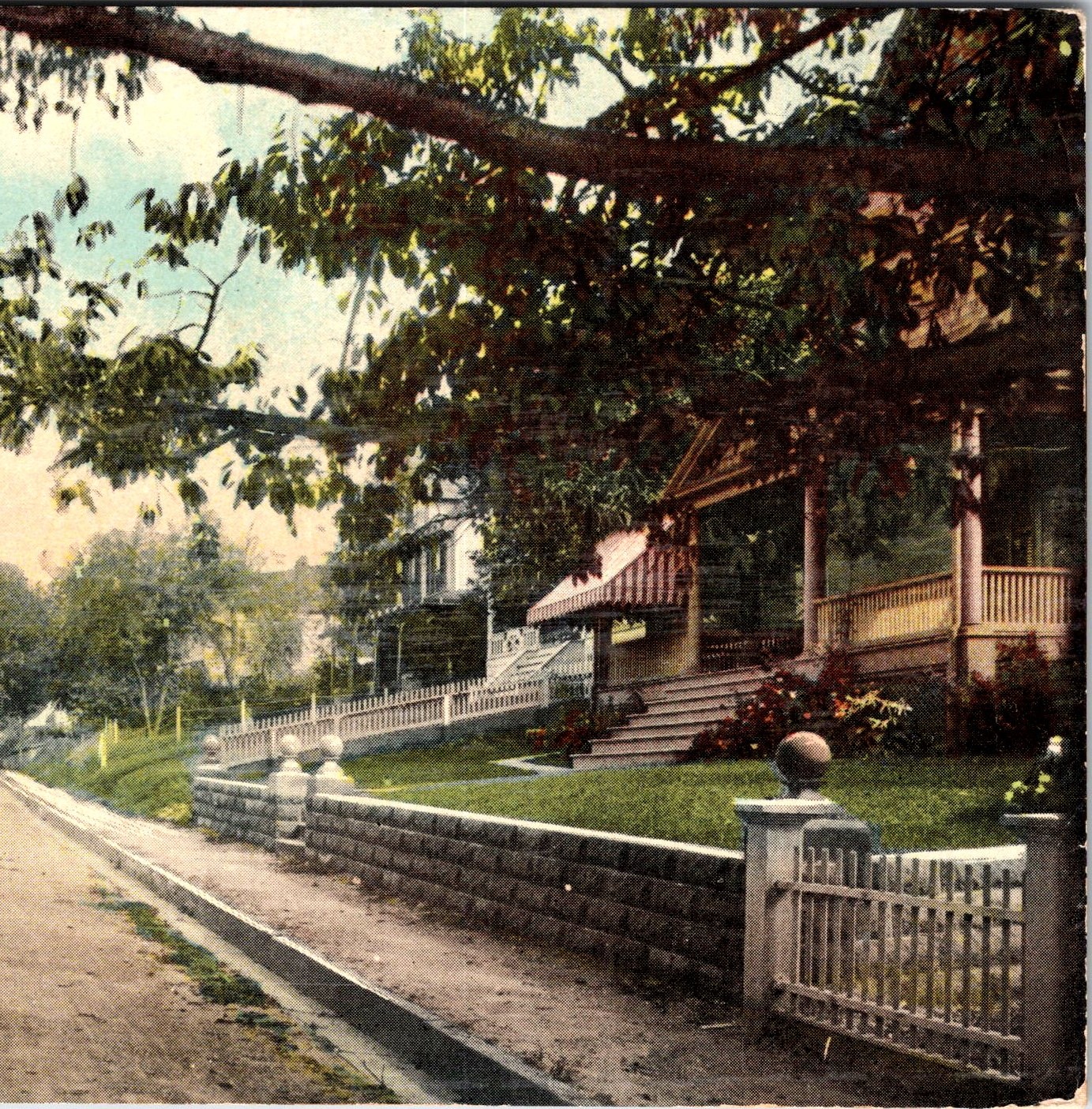
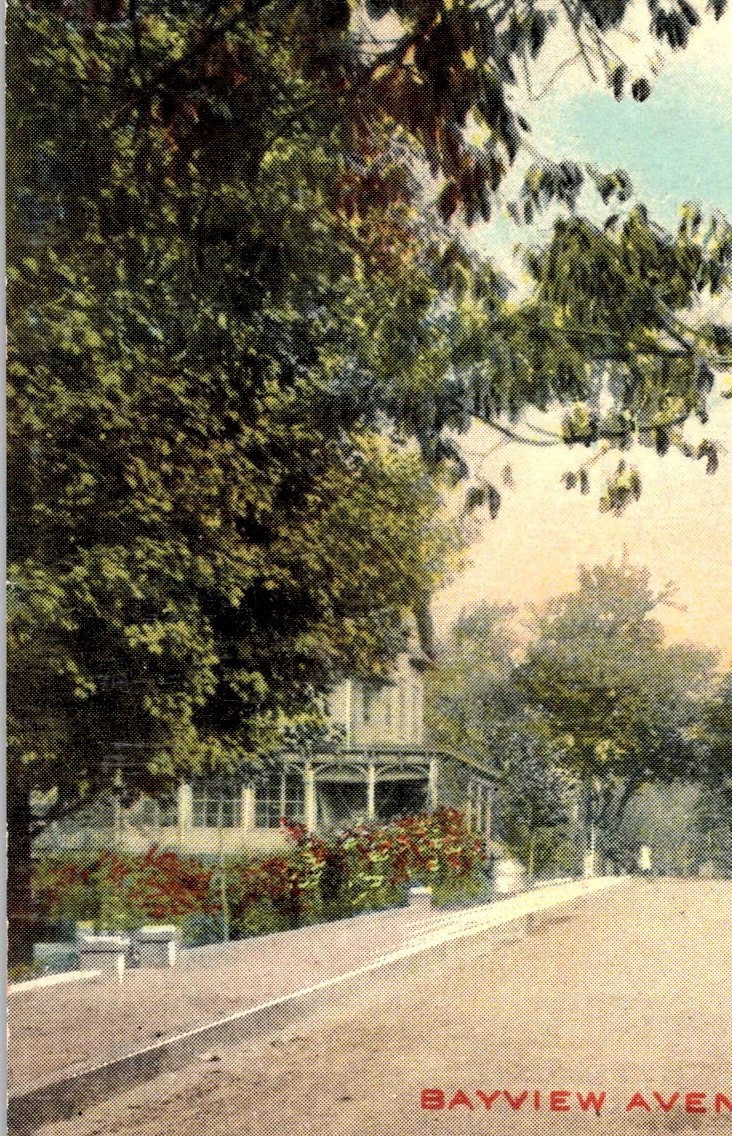
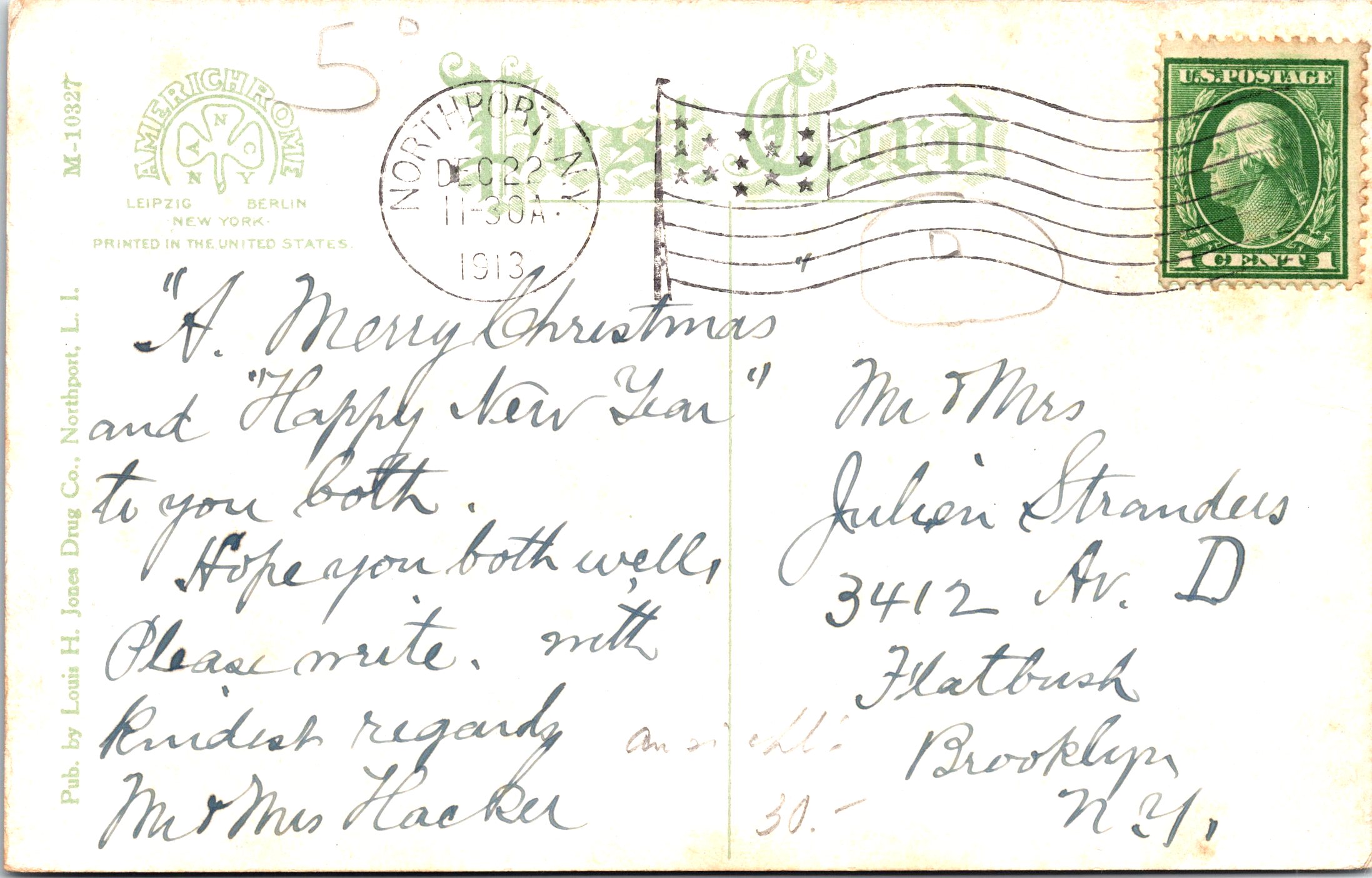
This lithographic postcard features a street scene in Northport, Long Island, New York. The postcard pictures Bayview Avenue in 1913. The road, sidewalk, houses and trees, look very much like the street looks today. The picturesque road runs along the edge of Northport Harbor (Long Island Sound), and was beautiful than, and beautiful now. This postcard was published by the Louis H. Jones Drug Company. The firm was located in Northport. The message includes holiday greetings and the addressee lived in Flatbush, Brooklyn, New York. SOLD
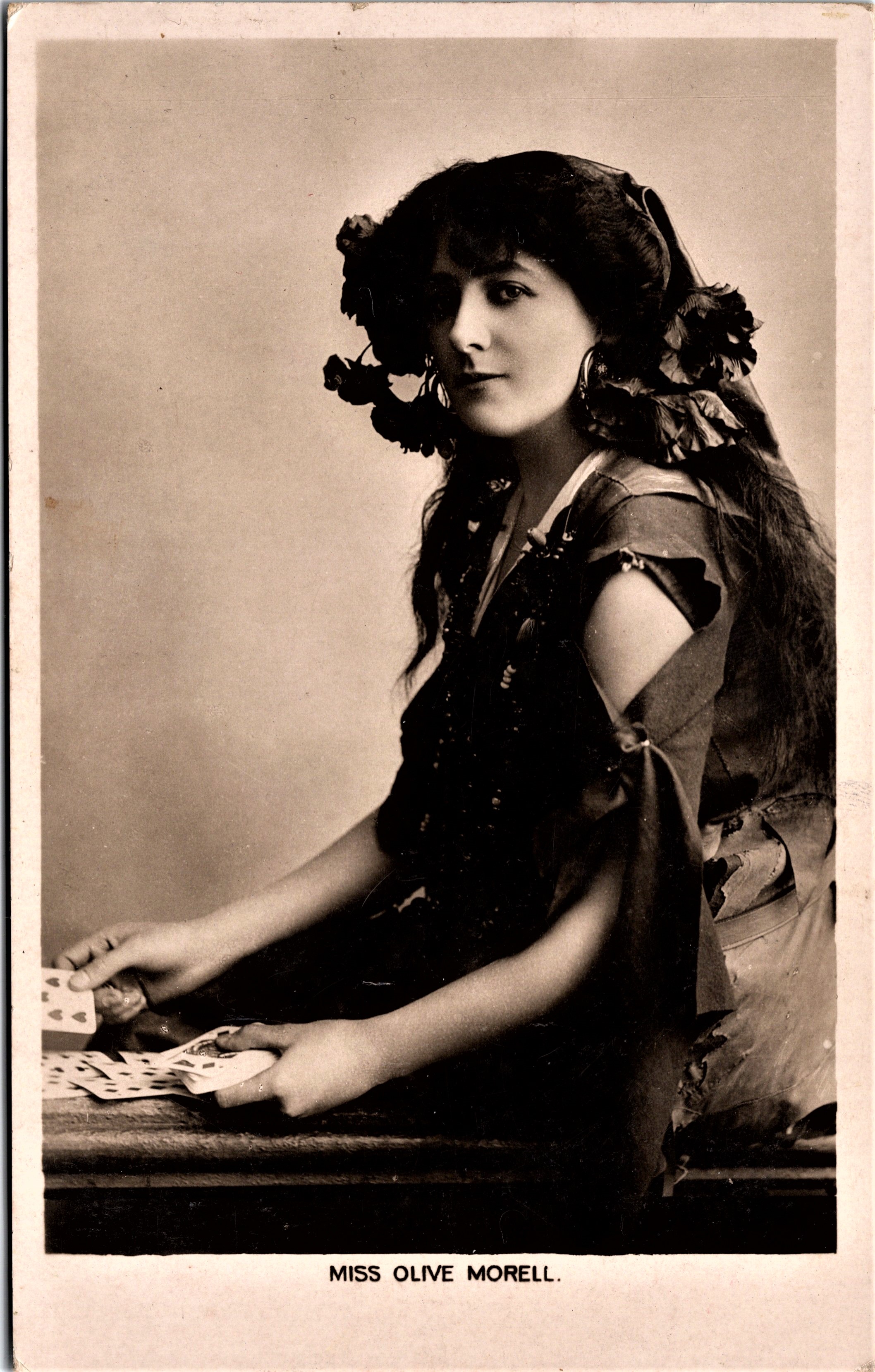
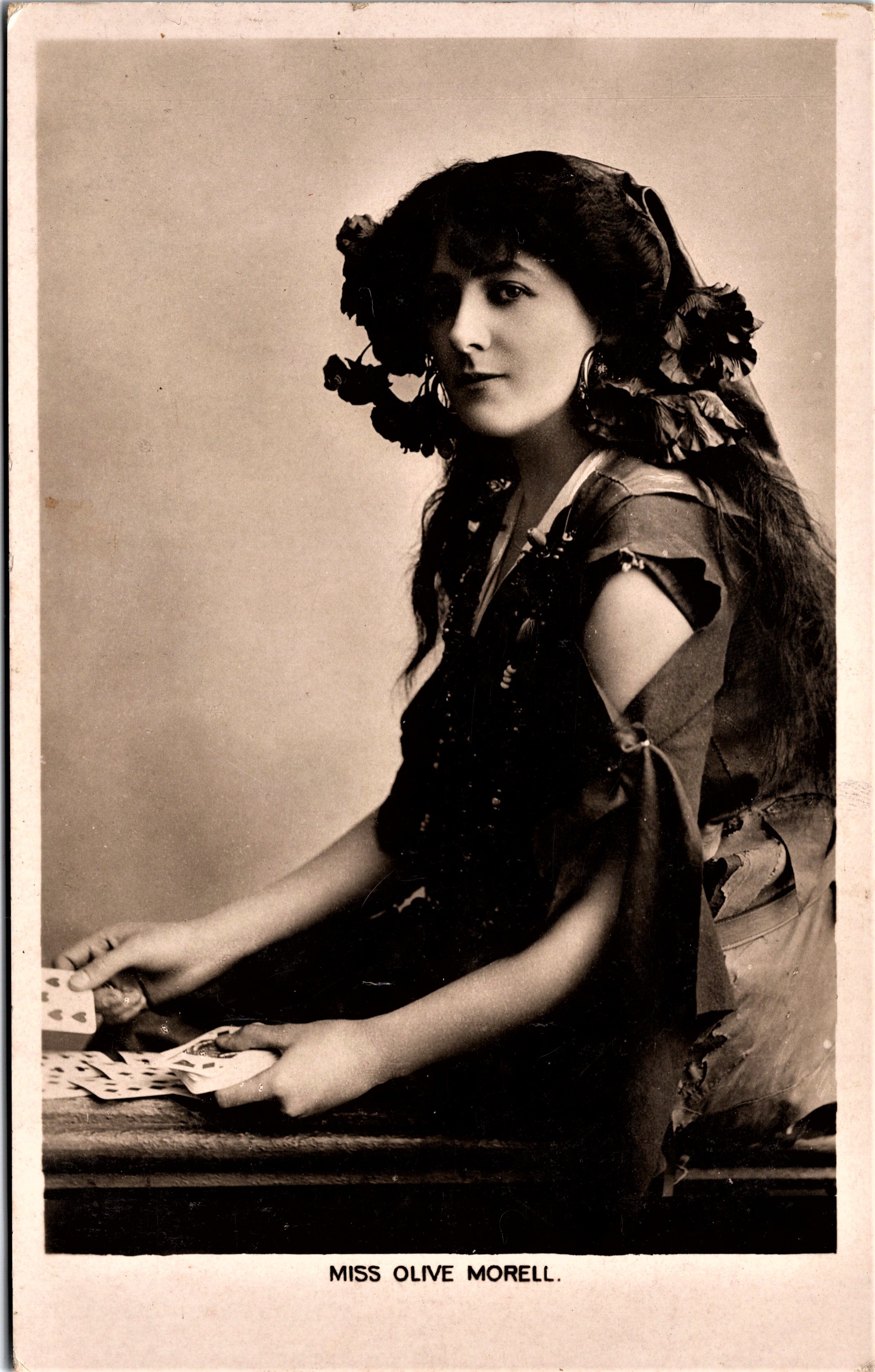
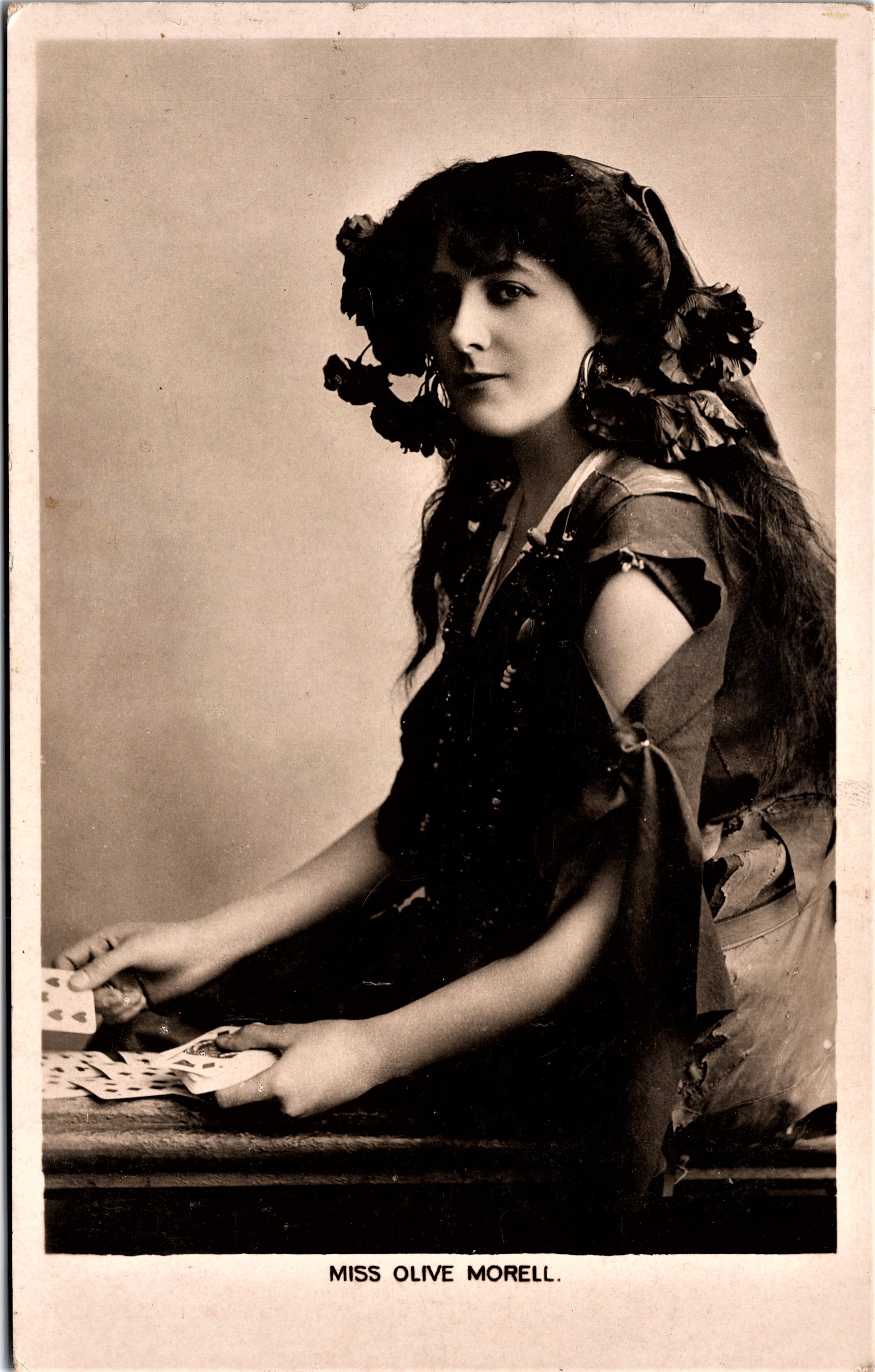
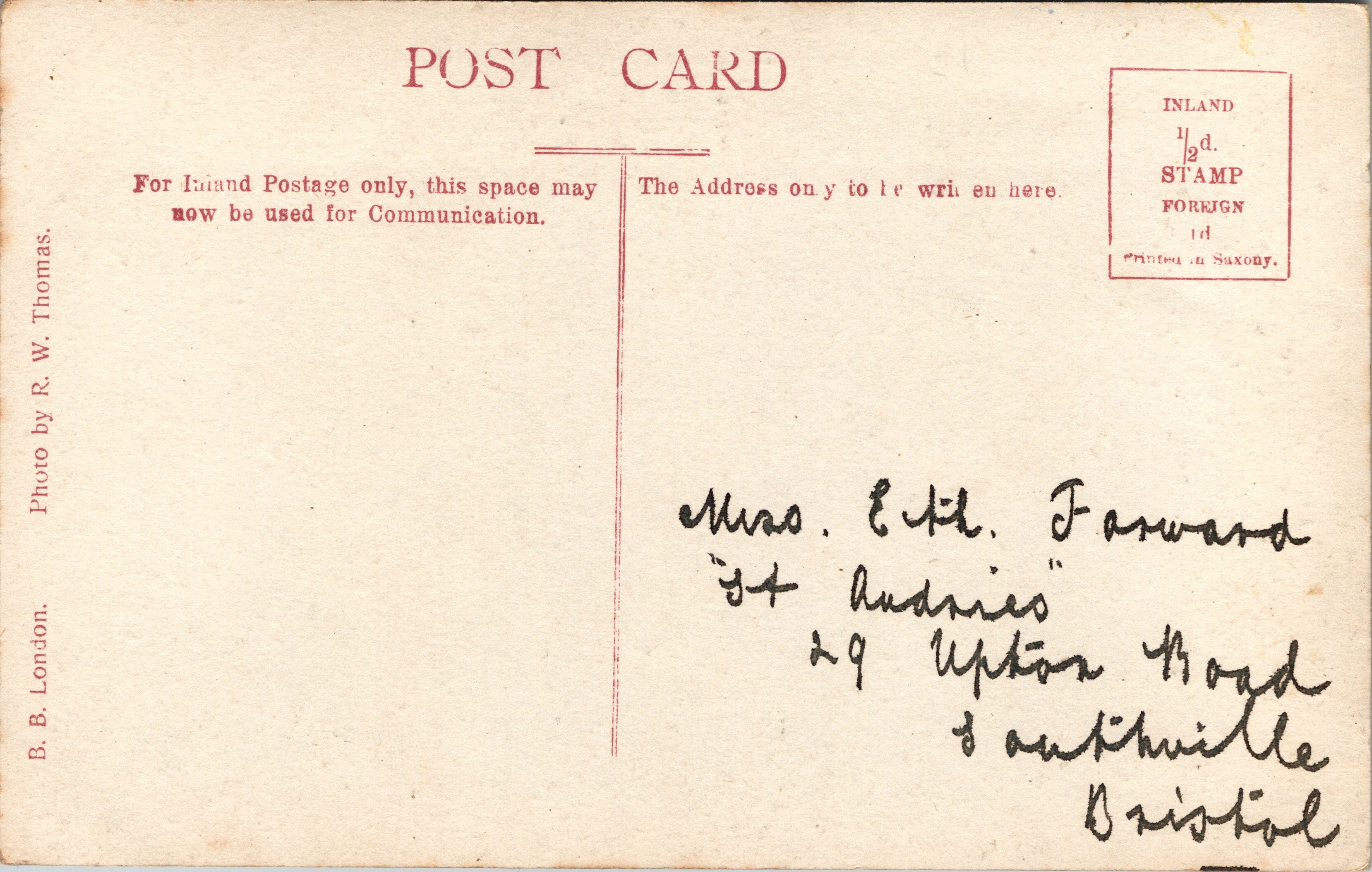
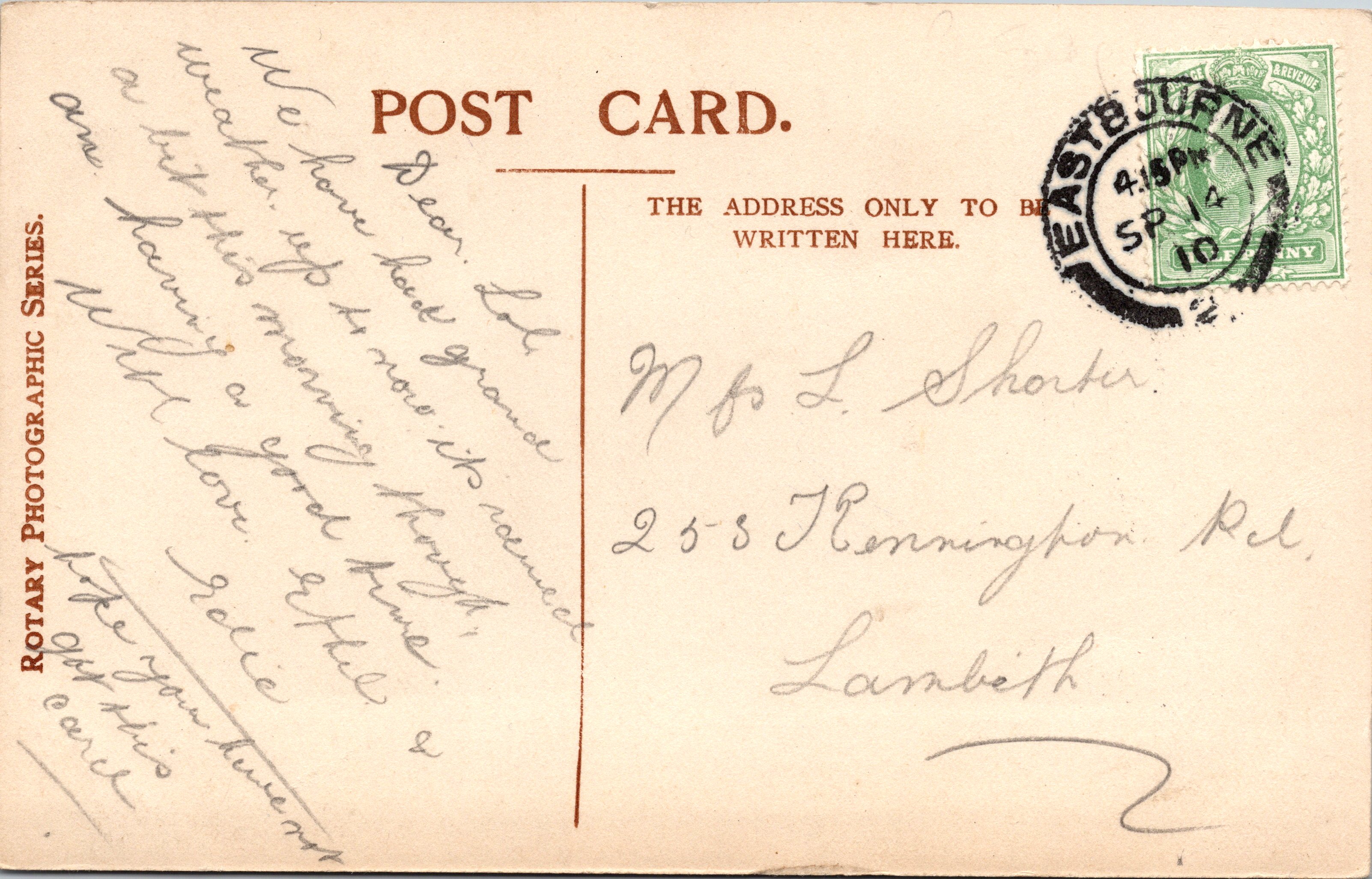
This vintage real photo postcard features English actress and Gaiety Girl, Olive Morrell (1877-1937). In this portrait postcard, she is holding playing cards. Morrell is most associated with her roles in Edwardian musical comedies. Olive was raised in Highgate, near London. An introduction by her singing teacher, led her to theatrical producer George Edwardes. The introduction opened a path for her to perform at London’s Gaiety Theater. Olive was a gaiety girl. Gaiety Girls was the name given to the chorus girls acting in the musical comedies at the theater. The “girls” were beautiful and they danced and modelled bathing suits and the latest fashions onstage. The gaiety girls were considered more respectable than the women performing at London’s burlesque houses. Morrell was a very popular real photo postcard model. Reviewers of her stage performances often commented about her beauty. In 1908, Olive was married to an Australian politician, Willie Kelly. The publisher of this postcard was a London firm (B. B.). Olive’s photo portrait was taken by R. W. Thomas. The postcard dates back to about 1906. This vintage postcard is in very good condition (see scans).
Buy this original Vintage Real Photo Postcard (includes shipping within the US) #5329
To purchase this item, click on the Pay with PayPal button below
$12.48
Buy this original Vintage Real Photo Postcard (includes international shipping outside the US) #5329
To purchase this item, click on the Pay with PayPal button below
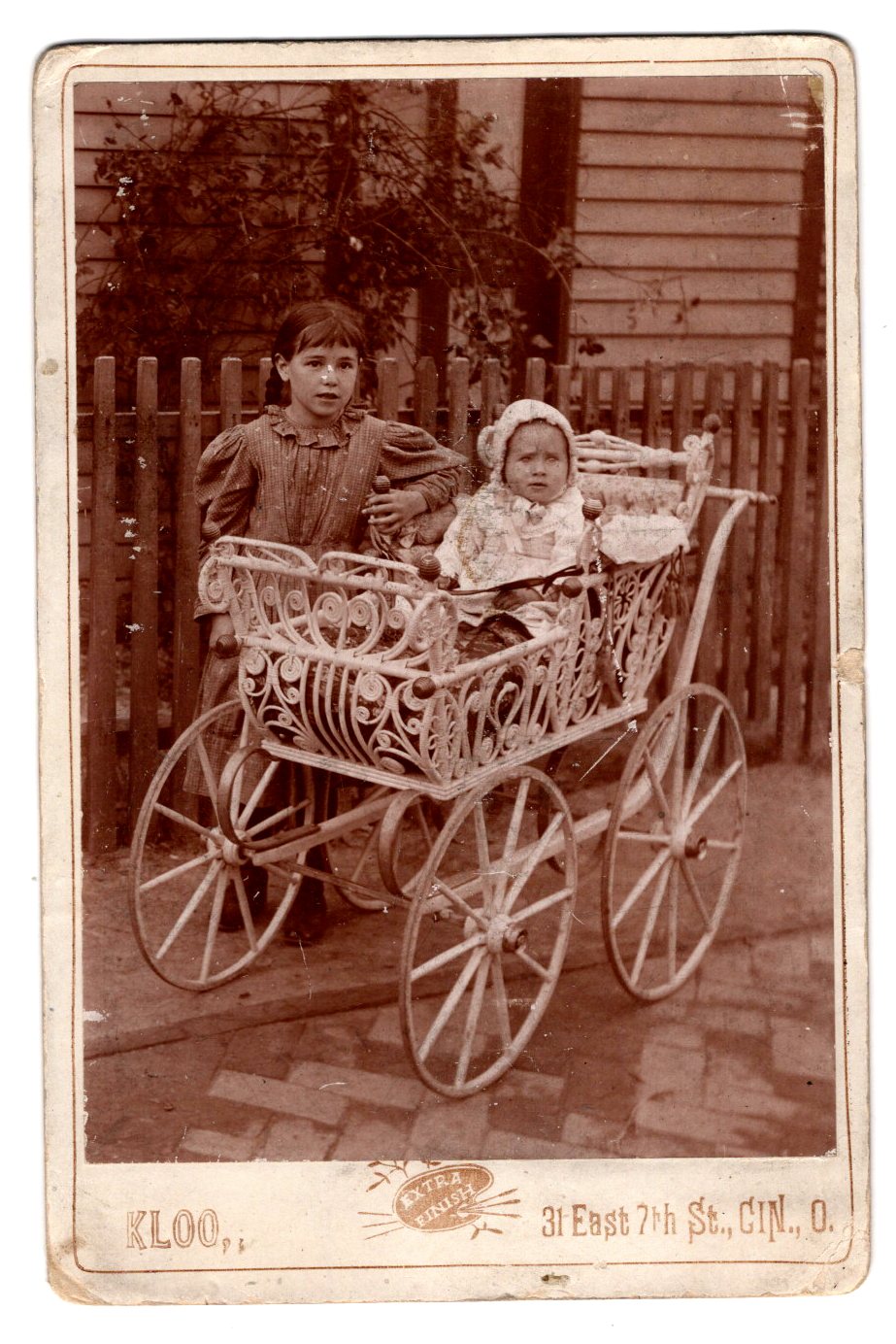
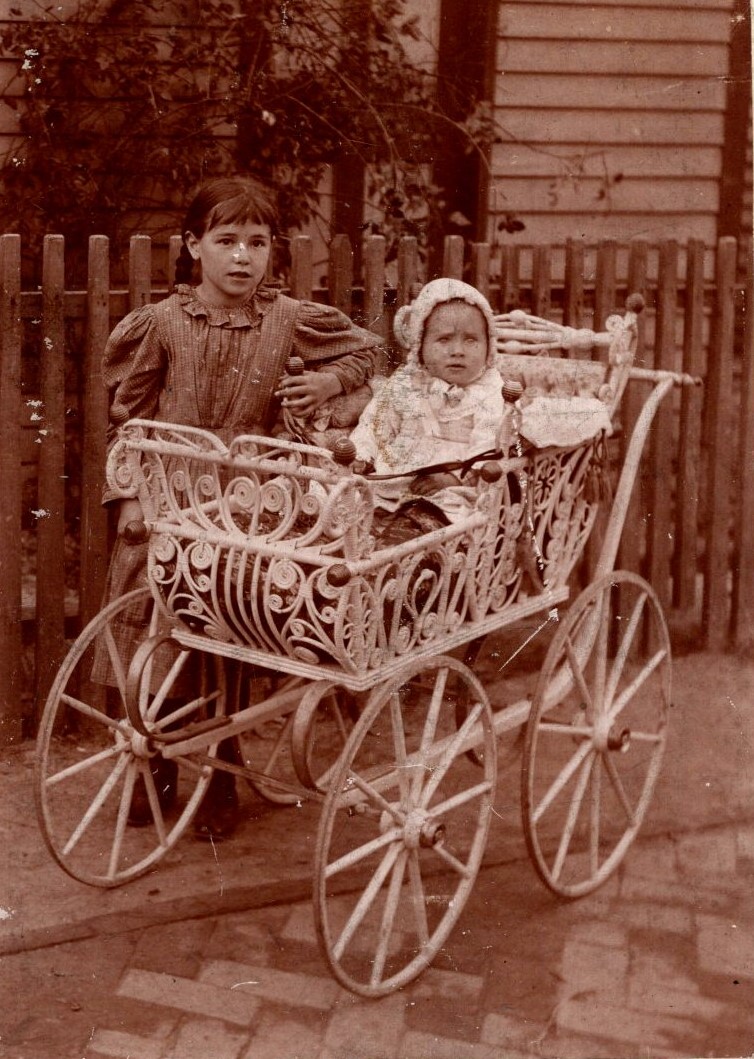
This cabinet card features a school age girl minding a bundled up baby in a large fine bentwood and wicker baby carriage. The carriage is on a brick lane and in the background is a fenced clapboard house. The older child is wearing a fine dress with mutton sleeves and the baby is clothed in a gown and cute cap. The photographer is Kloo, of Cincinnati, Ohio. The photographer may be Carl H. Kloo ,who, according to a photography journal (1906) was a photographer in Covington, Kentucky . SOLD
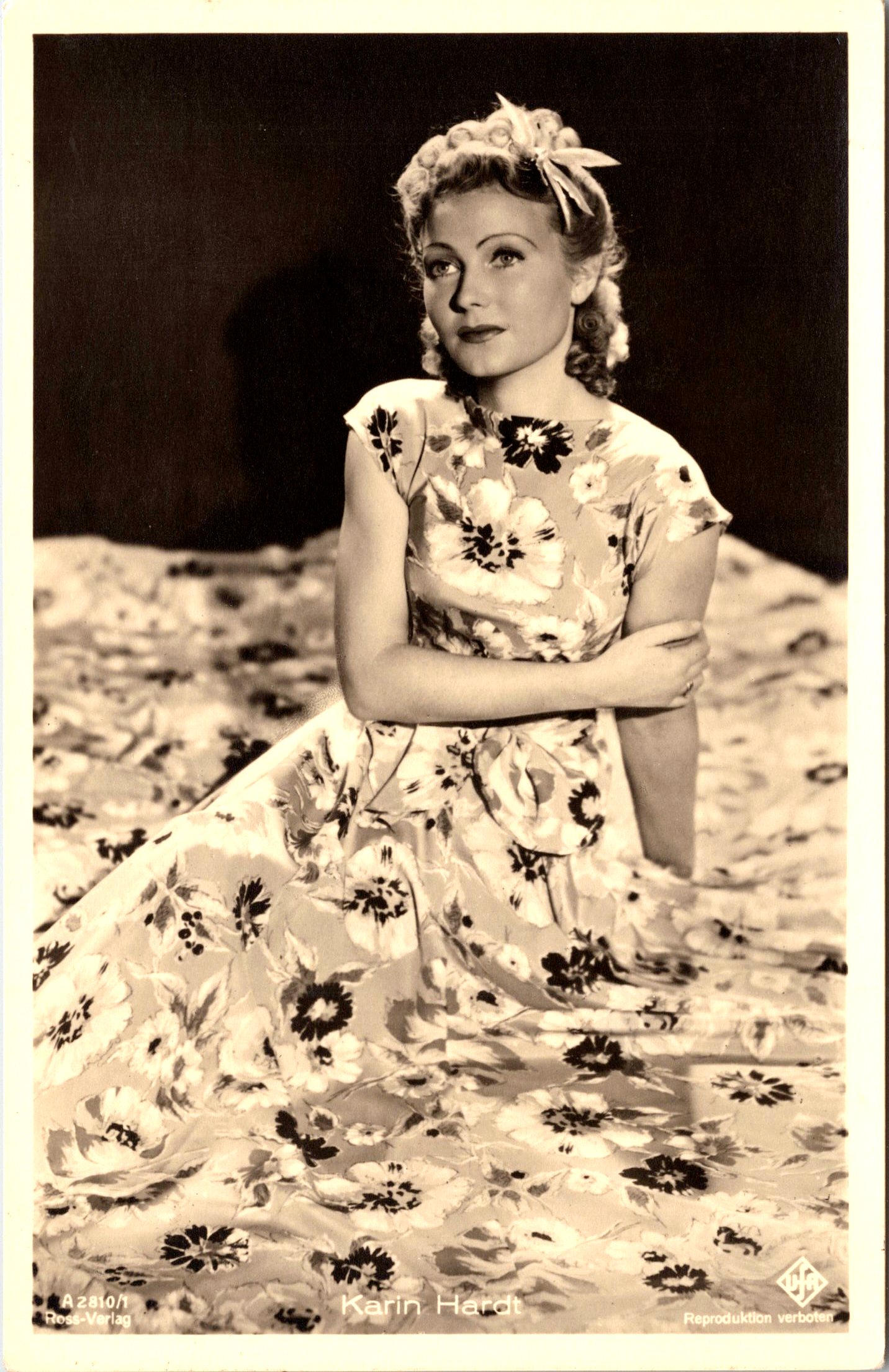
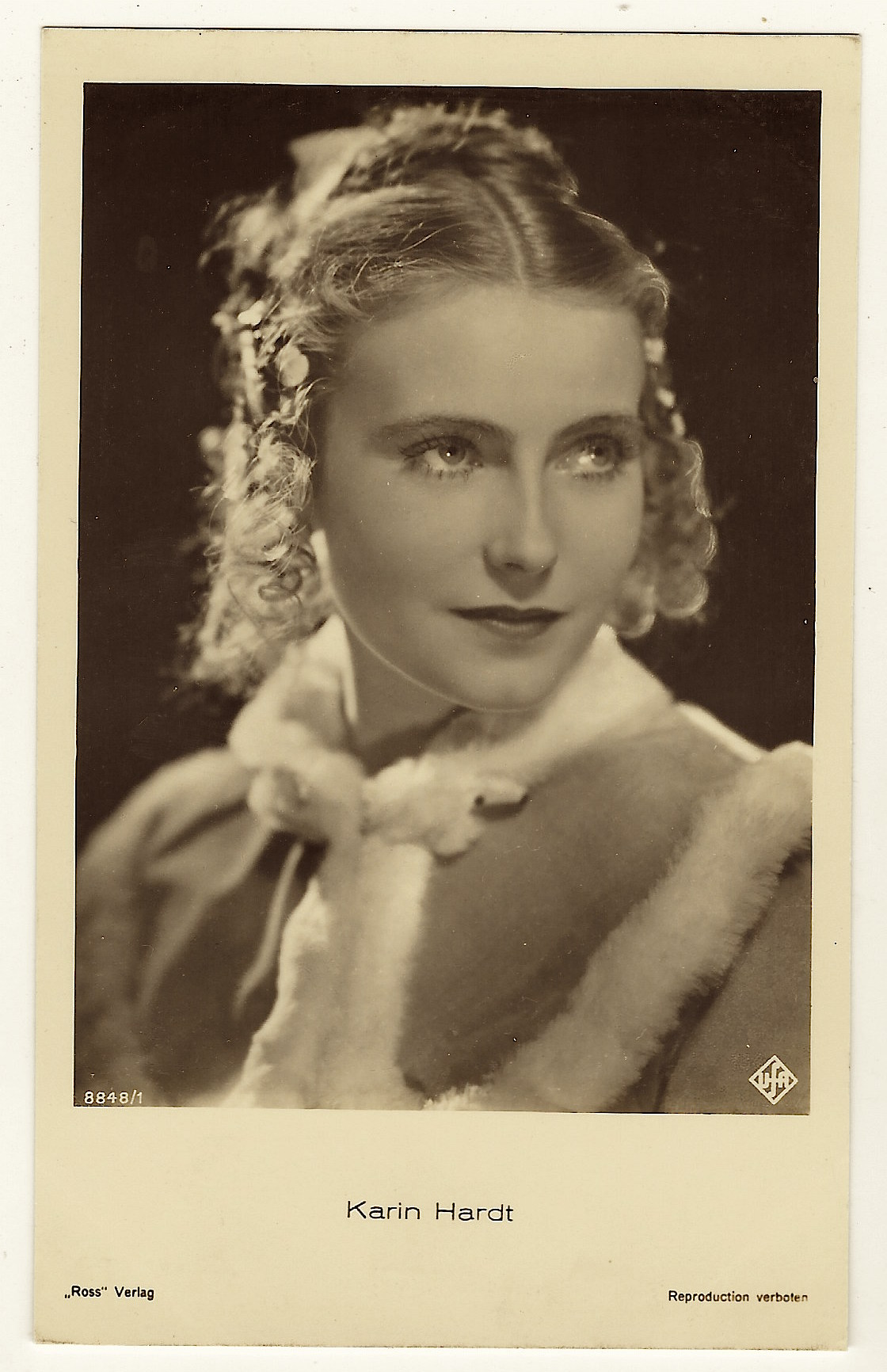
Karin Hardt (1910-1992), German film actress, is featured on these two vintage real photo postcards. Her father was a merchant. She took private acting lessons with Alex Otto, a German actor and theater director. After some theatrical appearances, she made her movie debut in 1931. She quickly rose to stardom. During the war years, her film roles decreased. Post war, she appeared in only a few more films. In the 1960’s she appeared in a number of television roles. She was married to director Erich Waschneck in 1933. She later married Rolf von Goth, a German actor. An internet filmography indicates that Hardt appeared in 88 films from 1931 through 1992. In 1979, she was in a film with David Bowie. The YouTube video below features Miss Hardt in the film, “Mens Economy” (1941).
The image in Postcard 1 gives the appearance that Hardt is about to be swallowed up by her dress. She is wearing ribbons in her hair and a sweet half smile. This photo postcard was published by Ross Verlag and is part of a series (no.A2810/1). The logo for UFA, a German film company, can be seen in the right hand bottom corner of the image. SOLD
Postcard 2 was published by Ross Verlag and is part of a series (no.8848/1). The logo for UFA, a German film company, can be seen in the right hand bottom corner of the image. This vintage postcard is in excellent condition (see scans).
Buy this original Vintage Real Photo Postcard (includes shipping within the US) #2620
To purchase this item, click on the Pay with PayPal button below
$22.00
Buy this original Vintage Real Photo Postcard (includes international shipping outside the US) #2620
To purchase this item, click on the Pay with PayPal button below
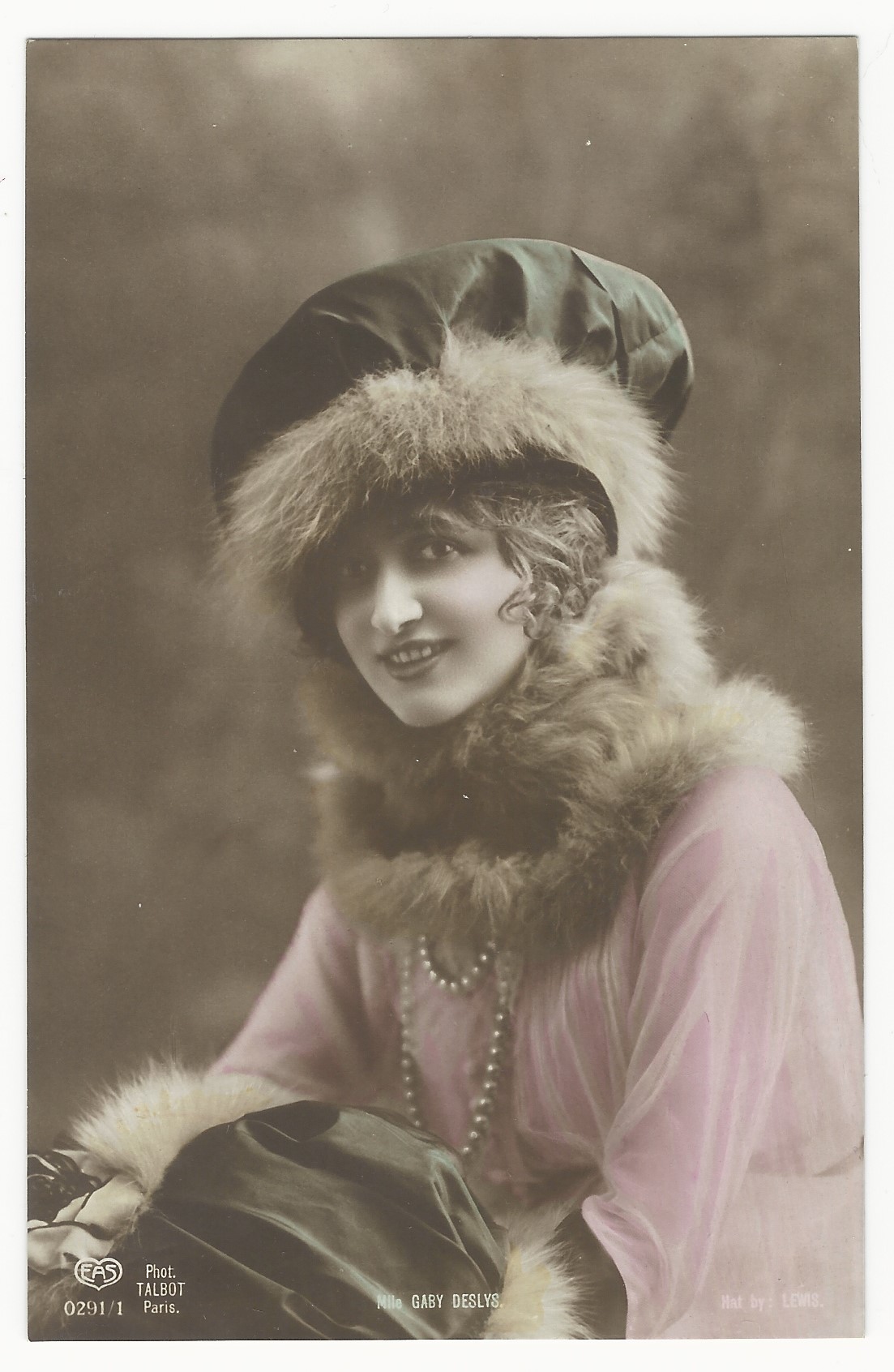
Vintage real photo Postcard 1 features a portrait of the multi talented actress, dancer, and singer, Gaby Deslys (1881-1920). Miss Deslys performed at the beginning of the twentieth century in both Europe and the United States. She was extremely popular worldwide. In fact, she was able to earn four thousand dollars a week when performing in the United States. She performed several times on Broadway. She had a dance named after her, “The Gaby Glide” (1911). You can find the sheet music, with Gaby on the cover, elsewhere on ebay. Her love life was the topic of much public gossip. She probably added to the sensationalism surrounding her by posing in a number of risque postcards. She was courted by many wealthy and powerful men, including the King of Portugal. Her life was cut short by the “Spanish” influenza. Postcard 1 is not at all common. It was published by E. A. Schwerdtfeger Company of London and printed in Berlin (no. 0291/1). The company also had an office in New York (opened in 1910). This publishing house printed many different types of real photo postcards but was known for its hand-colored real photo postcards of actresses and fashionable women in exotic costumes. The photographer was the Talbot studio. The creator of Miss Deslys’s hat is also credited (Lewis). This particular real photo postcard stands out because it offers a colorized and very clear view of this beautiful and talented performer. SOLD
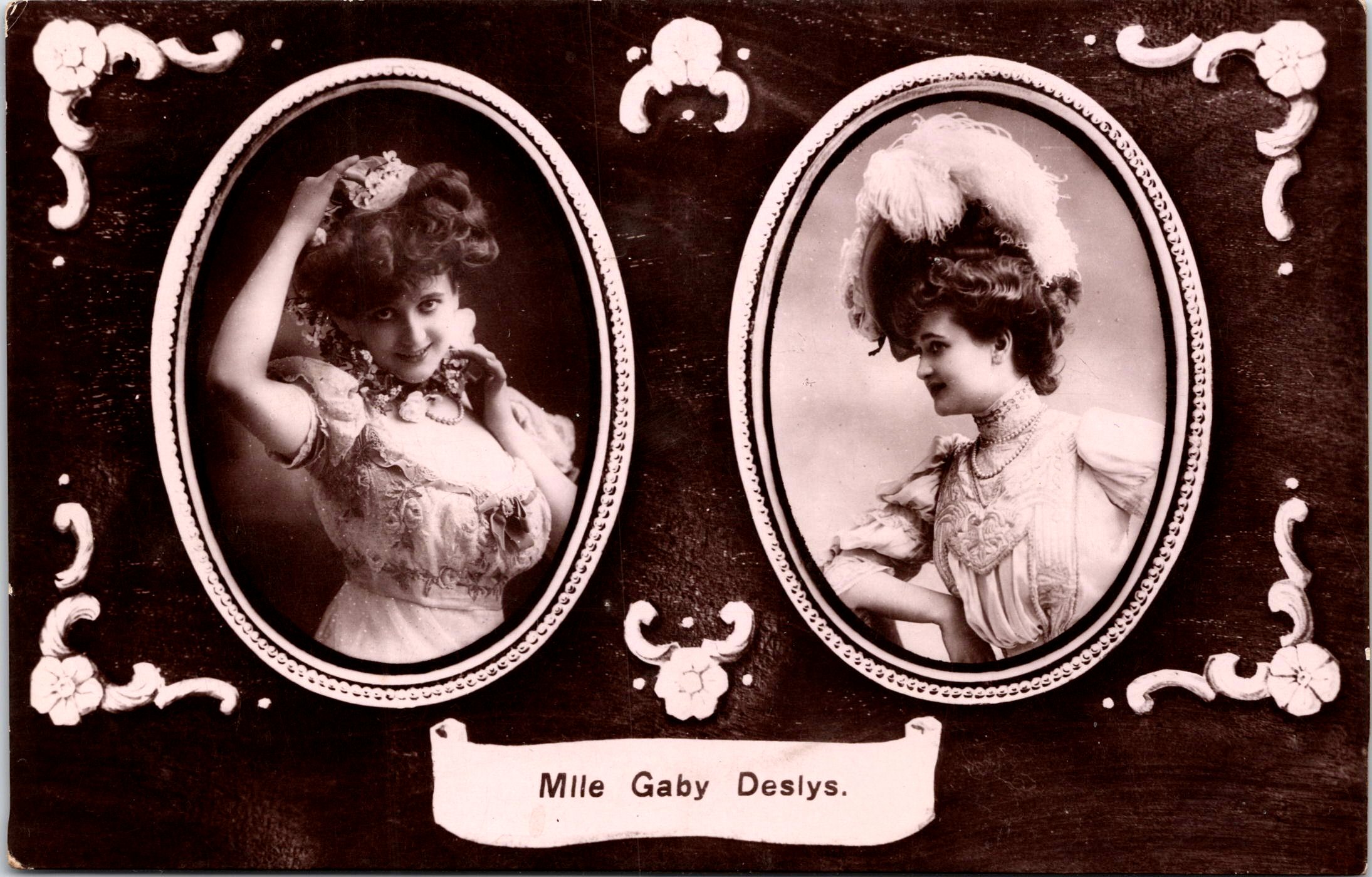
Postcard 2 was photographed by Edouard Stebbing. He was active in Paris between 1890 and 1910. Stebbing taught at a University in Paris and invented the stebbing camera, and was known for his work with emulsions. It is reported that he was friends with the artist Monet. He died in 1914 and his wife (Celestine) died five years earlier. Stebbing was a prolific photographer during the Belle Epoque Paris. He appears to have been an expatriate from England. He published many articles in British Photographic journals. Stebbing photographed many theatrical stars. A frequent publisher of these postcards was Monsieur G.Piprot, of “Etoille” or “Star” publishing in Paris. The “Photographic Times and American Photographer” (1883) cited Stebbing as “one of the bright lights of the French Photographic Society. The card has a 1908 postmark. SOLD
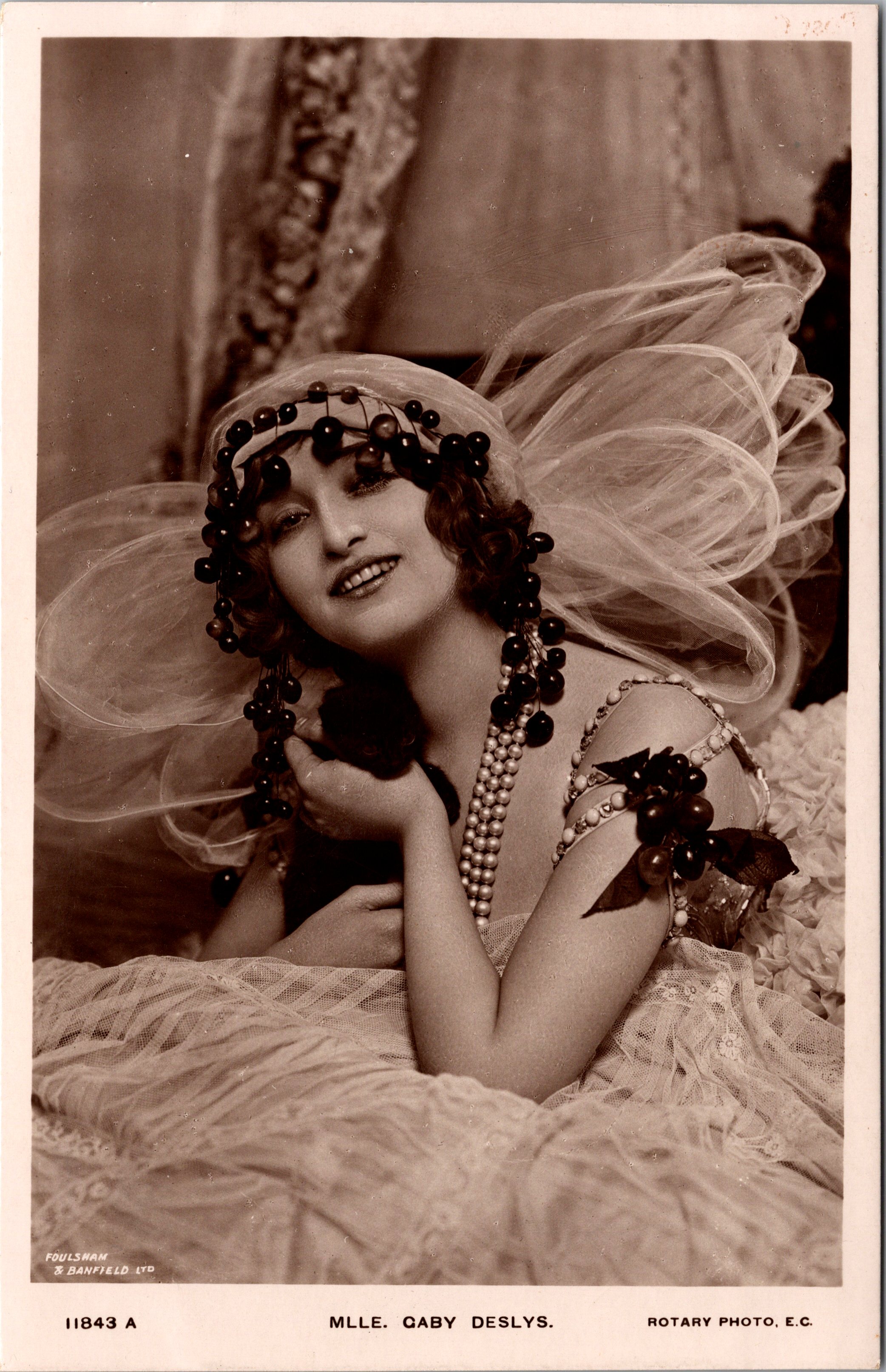
Postcard 3 is not common. It was published by Rotary Photo of Great Britain as part of a series (no.11843 A). This postcard portrait was taken by the Foulsham & Banfield studio. Gaby Deslys was certainly a beautiful and talented performer. SOLD
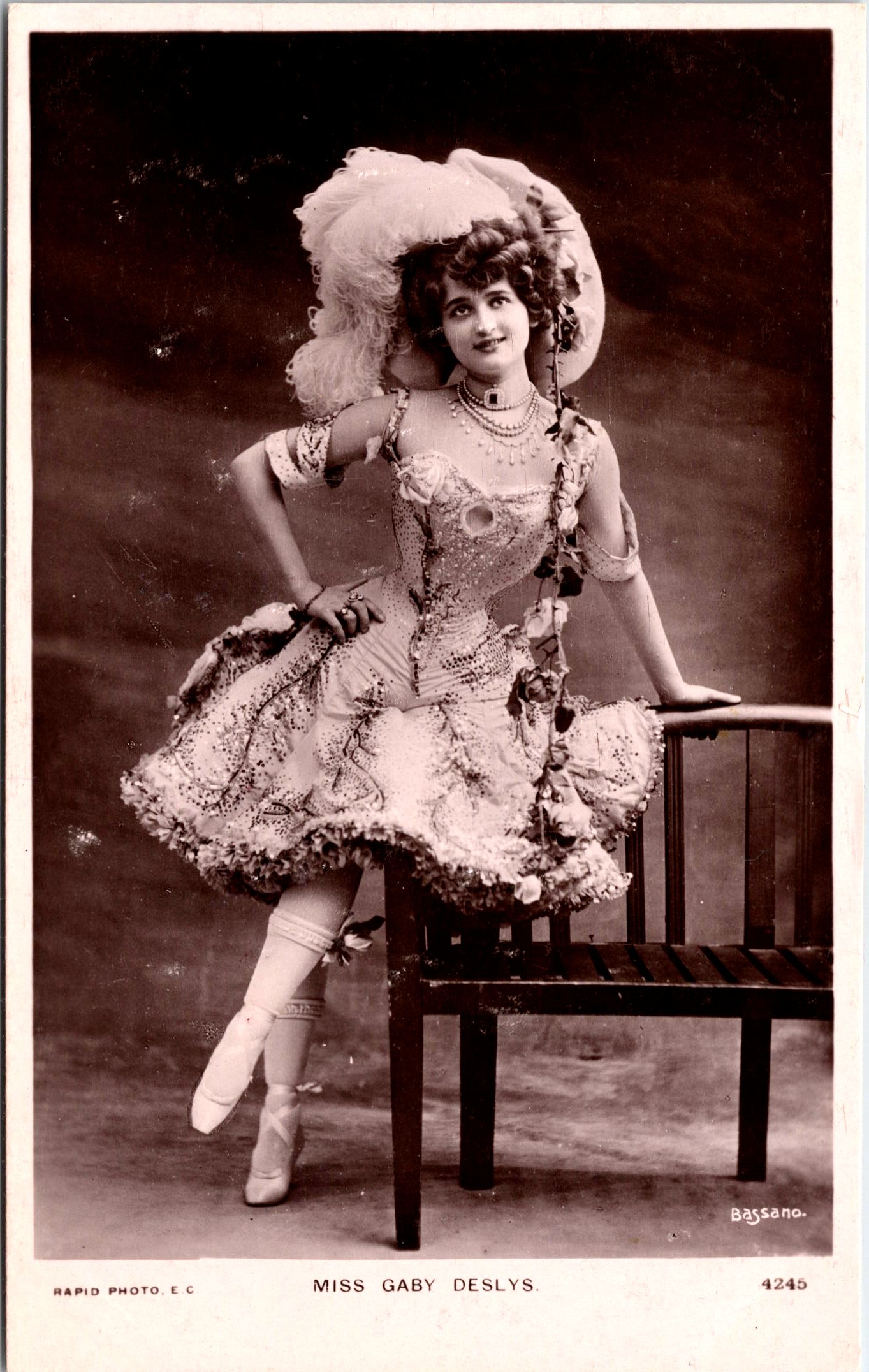
Postcard 4 was published by Rapid Photo of Great Britain as part of a series (no.4245). The company was active between 1901 and 1910. The firm specialized in taking theatrical portraits and was located in London. This postcard portrait was taken by the Bassano studio. SOLD
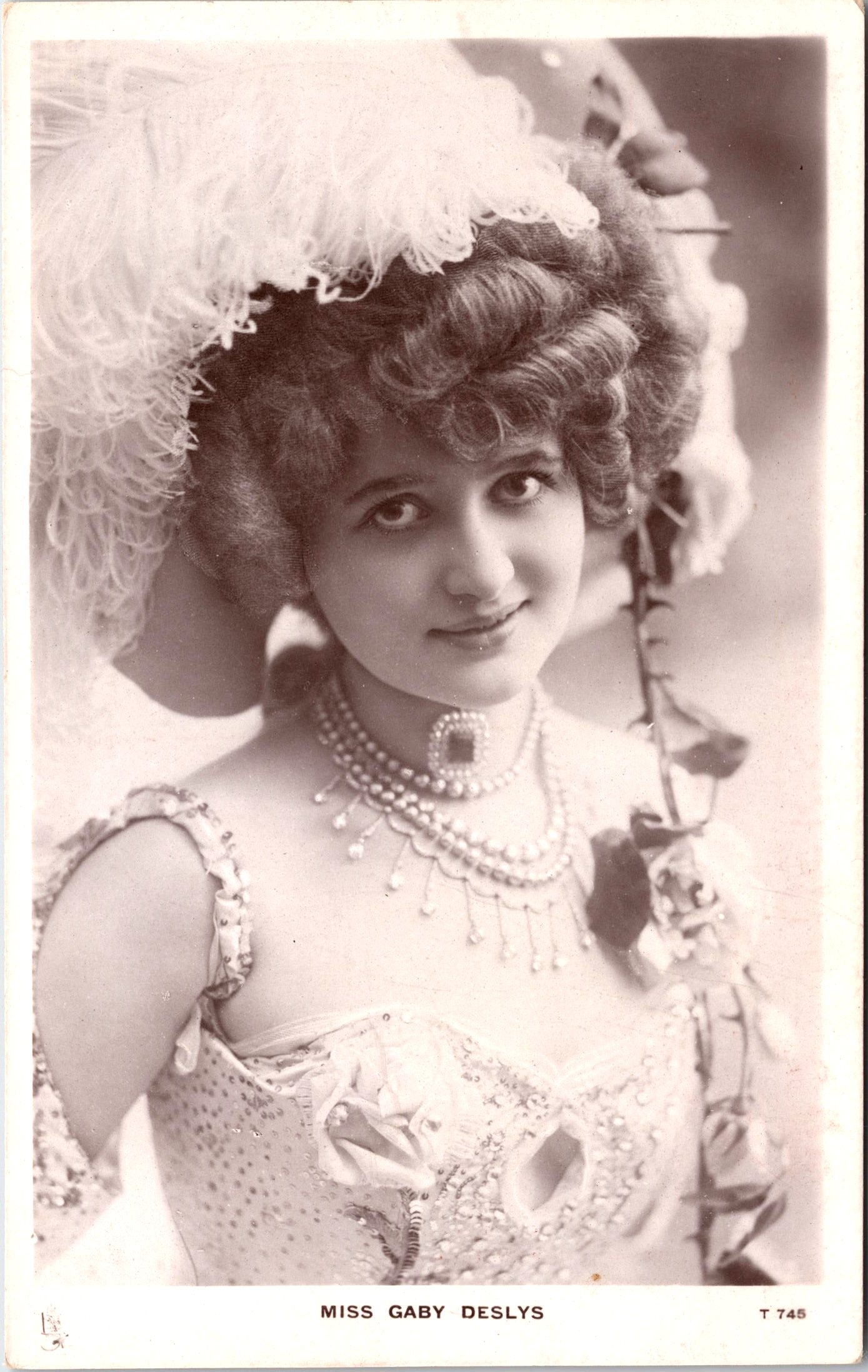
Postcard 5 was published by Raphael Tuck & Sons of Great Britain as part of the Celebrities of the Stage series (no.T745). The company produced a variety of postcards including an extensive catalog of celebrity (stage and screen) portrait postcards. The firm began publishing this Deslys postcard in 1903. Miss Deslys was photographed by Dover Street Studio for the portrait seen on this postcard. (SOLD)
Postcard 6 was published by J. Beagles of Great Britain as part of a series (no.70H). This real photo postcard is uncommon. This risque vintage real photo postcard features Deslys wearing a provocative costume for her time. She is flashing an infectious smile. Note her corset assisted wasp thin waist.
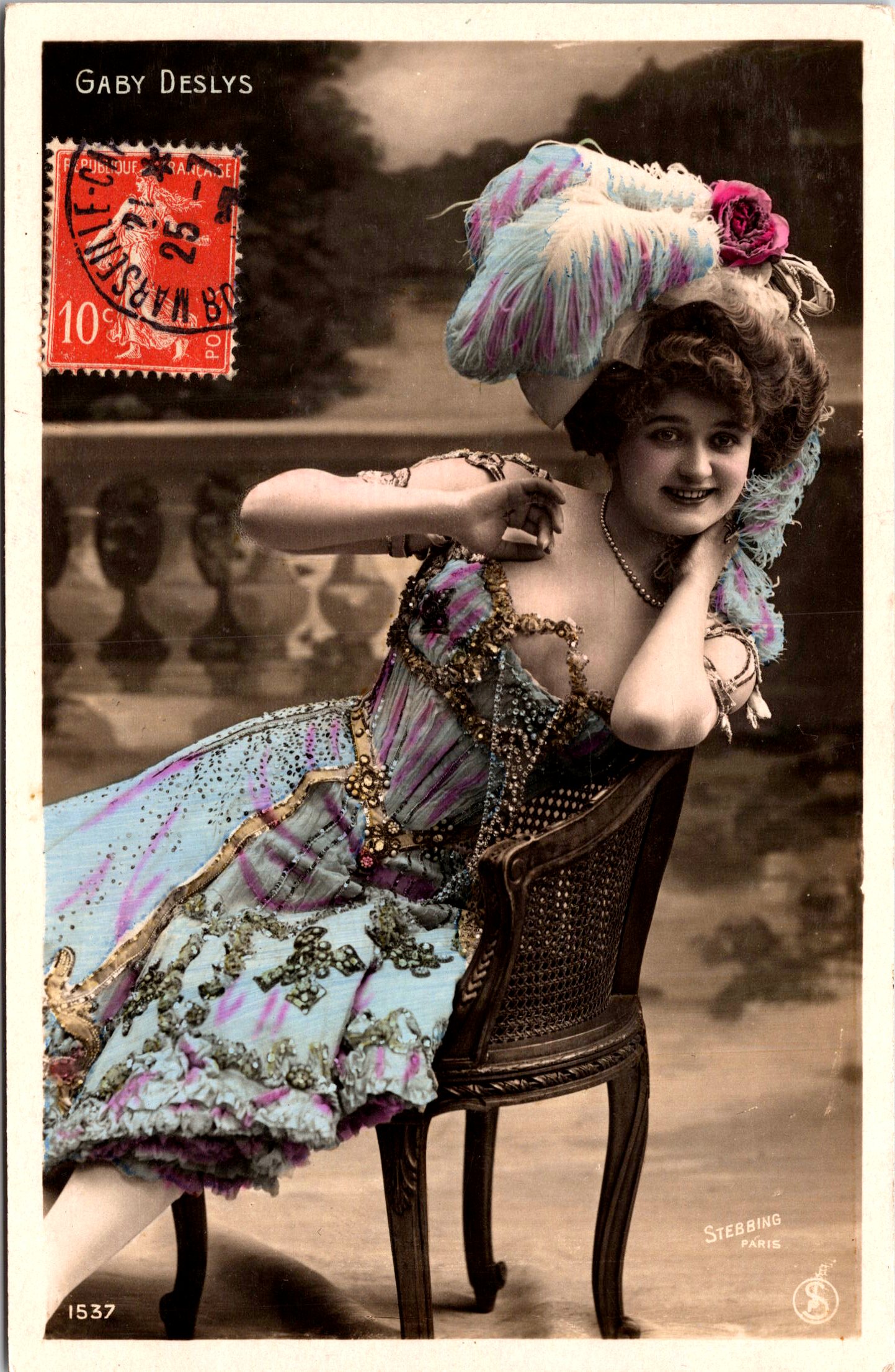
Postcard 7 was published by Societe Industrielle de Photograpie (SIP) of Rueil, France, and is part of a series (no.1537).The photographer was Edouard Stebbing who was active in Paris between 1890 and 1910. Stebbing taught at a University in Paris and invented the stebbing camera, and was known for his work with emulsions. It is reported that he was friends with the artist Monet. He died in 1914 and his wife (Celestine) died five years earlier. Stebbing was a prolific photographer during the Belle Epoque Paris. He appears to have been an expatriate from England. He published many articles in British Photographic journals. Stebbing photographed many theatrical stars. This real photo postcard is uncommon. (SOLD)
Postcard 8 is an uncommon vintage real photo postcard. It was published by Davidson Brothers of Great Britain. Davidson Brothers was located in both London and New York City. The firm operated between 1901 and 1911. (SOLD)
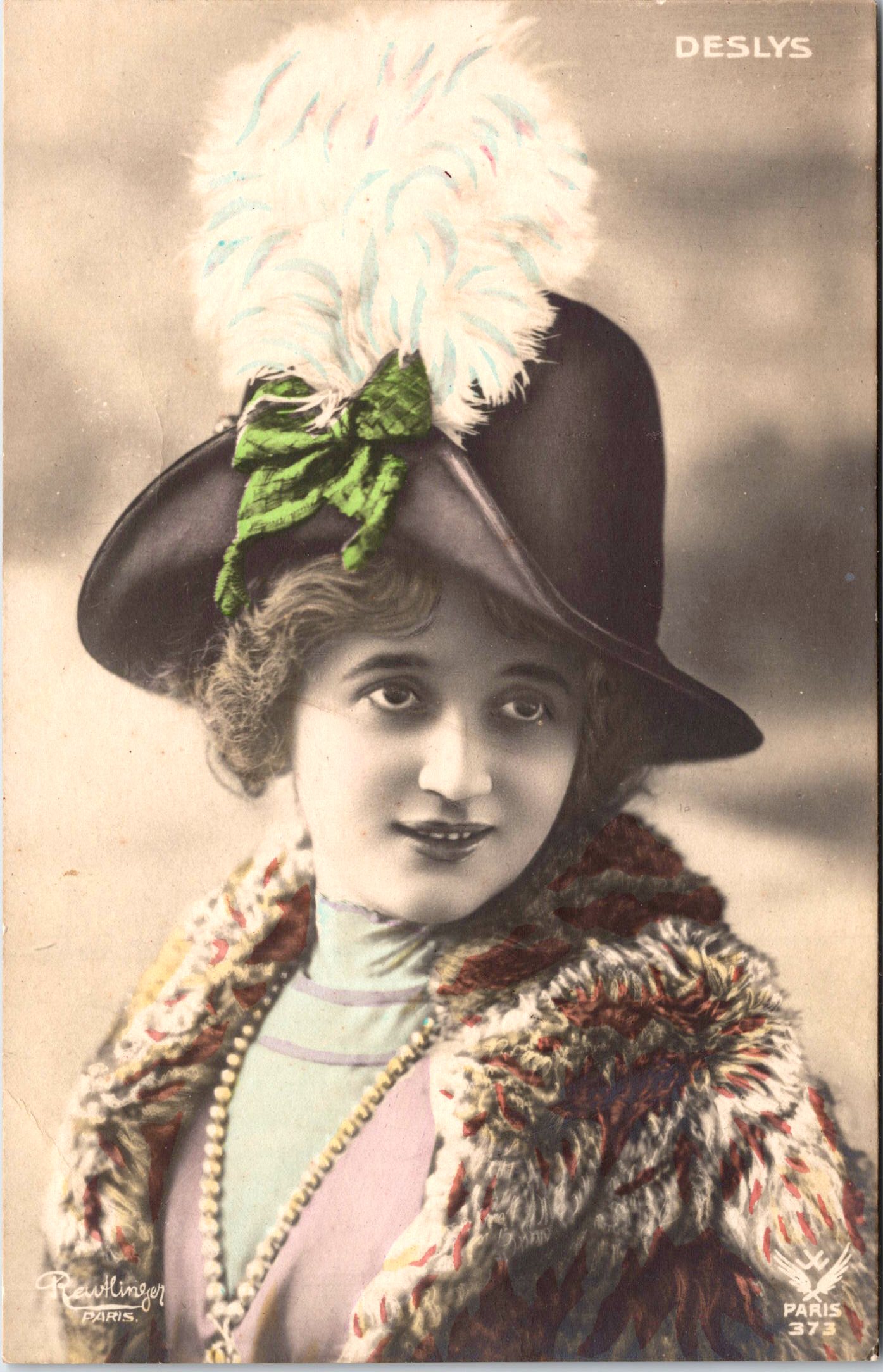
Postcard 9 has a portrait taken by esteemed celebrity photographer, Leopold Reutlinger. This real photo postcard is very uncommon. Gaby Deslys was certainly a beautiful and talented performer. (SOLD)
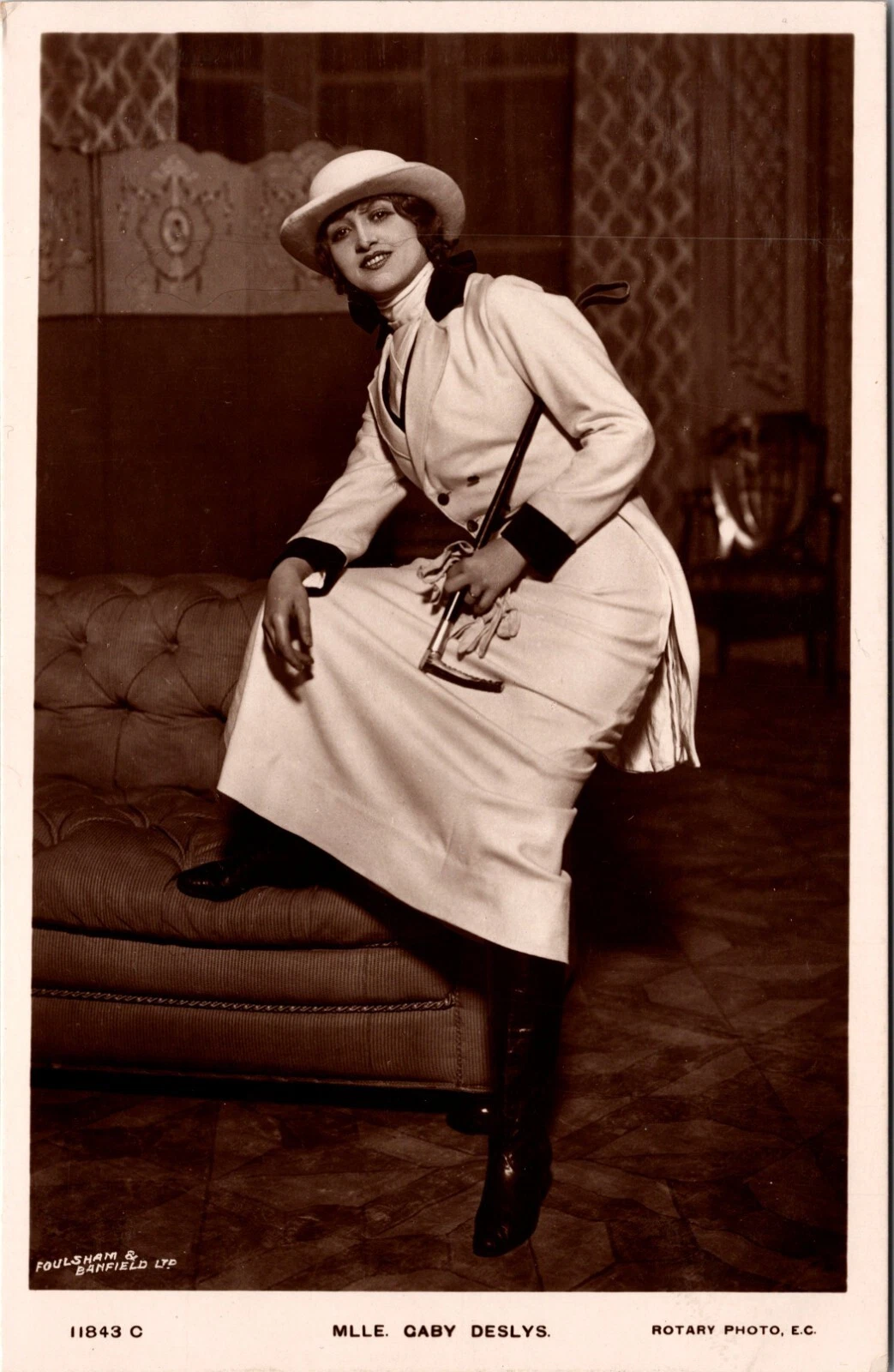
Postcard 10 is not at all common. It was published by Rotary Photo of Great Britain as part of a series (no.11843 C). This postcard portrait was taken by the Foulsham & Banfield studio. SOLD
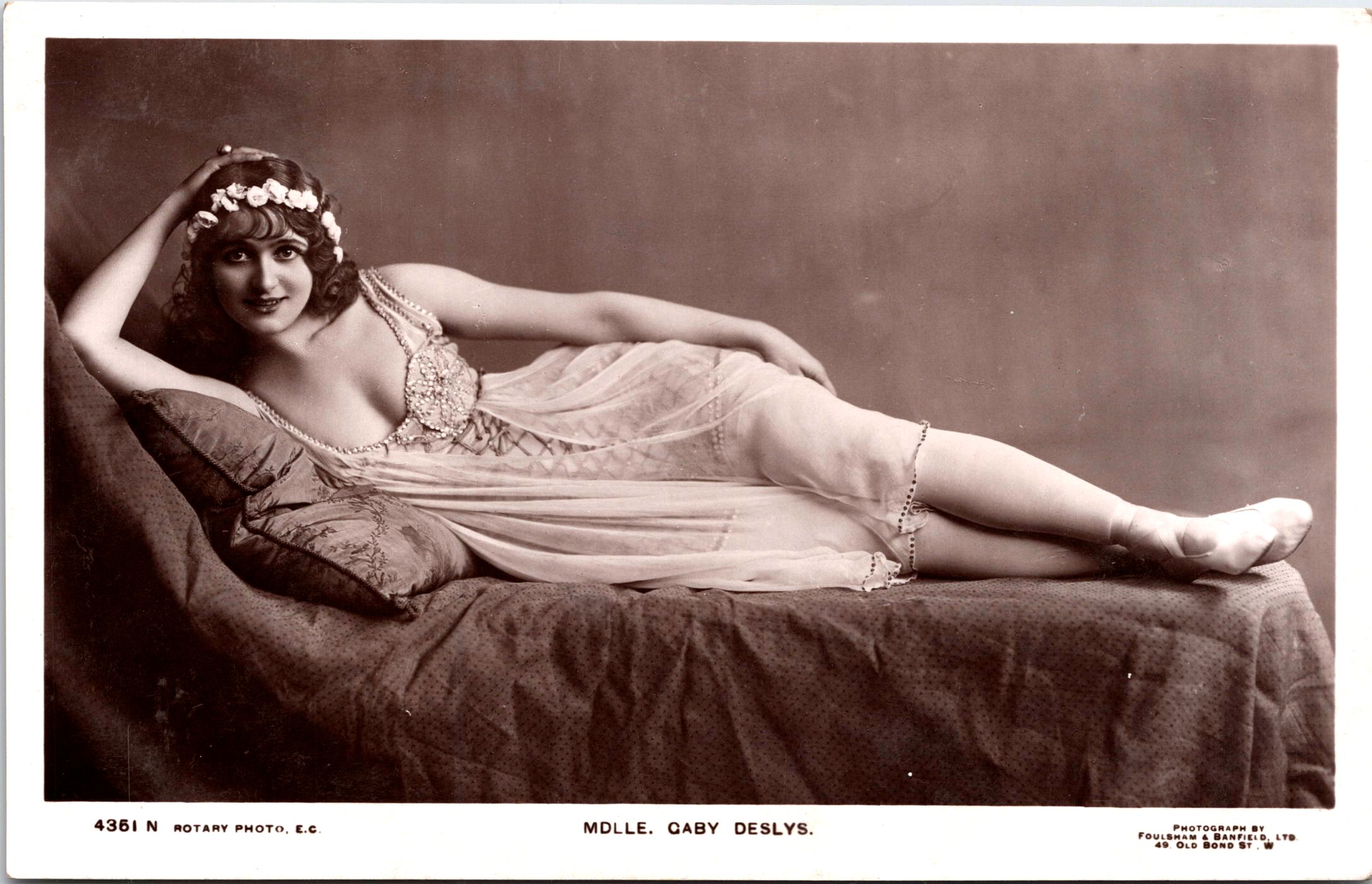
Postcard 11 captures Deslys in a pose that blends theatrical glamour with unabashed sensuality. Reclining languidly on a divan, Deslys gazes directly into the camera with a confident, coquettish smile. Her expression, both inviting and self-assured, evokes the knowing charm that made her a sensation on both sides of the Atlantic. She is dressed in a diaphanous, low-cut gown adorned with delicate lace and sparkling embellishments. The sheer fabric reveals the contours of her form beneath, and the bodice dips dramatically to showcase her décolletage. A garter peeks out from beneath the hem of her dress, holding up one of her stockings—a provocative detail that contributes to the postcard’s risqué nature. At a time when societal norms placed great emphasis on modesty, such a revealing pose and costume would have been seen as daring, bordering on scandalous. Her hair is crowned with a wreath of artificial flowers, emphasizing both her stage persona and the romanticized ideal of feminine beauty in the Belle Époque. Every detail of this image—from the suggestive pose to the luxurious styling—speaks to Deslys’ identity as a performer who captivated audiences not just with her talent, but also with her bold charisma and sex appeal. The card is numbered 4361 N and was published by Rotary Photo, E.C., a major British publisher known for high-quality celebrity postcards. The photograph itself was taken by Foulsham & Banfield, Ltd., a prominent London studio located at 49 Old Bond St. W, famed for its theatrical portraits.
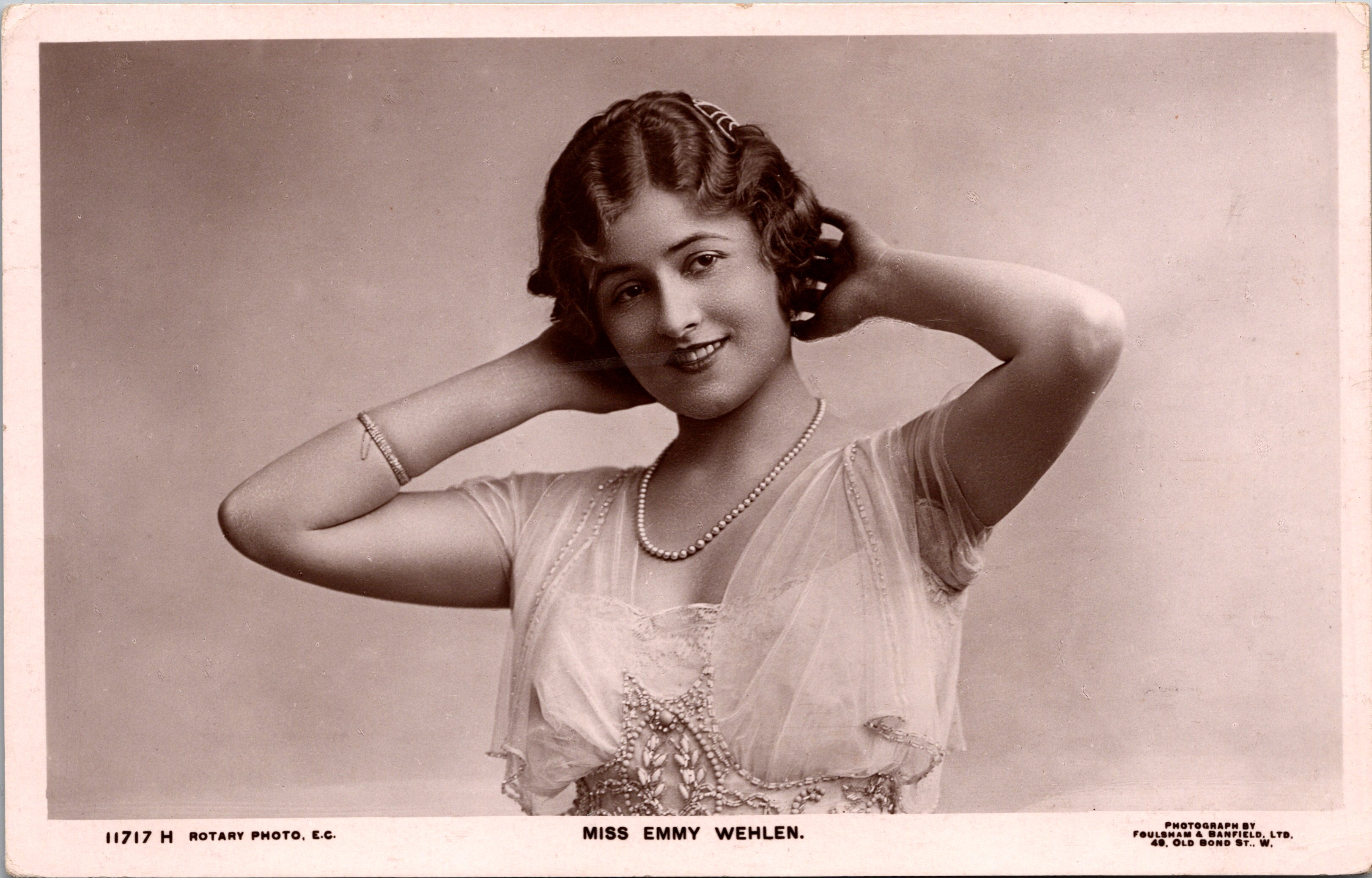
Postcard 1 features German actress, Emily “Emmy” Wehlen (1887-1977). She was a Edwardian musical comedy and silent film actress. She retired from acting at a young age (early 30’s), Wehlen received her musical training at the Mannheim Conservatory. She then joined the Thalia-Theatre and performed in musical comedies in several German cities. She was then invited to London and was considered as a possible successor to Lily Elsie. Wehlen played the lead role in “The Merry Widow” (1909). Later that year she appeared in the hit musical “The Dollar Princess” which ran for 428 performances. Next stop was New York, where she appeared in four Broadway plays between 1911 and 1915. Shortly after her last Broadway appearance, Wehlen left the stage and pursued a film career. She appeared in over twenty films between 1915 and 1920. “Everybody’s Magazine (1911) reported that Wehlen was very pretty and very graceful. Her acting and voice were also praised. In addition, the article stated that “she has the indescribable charm of personality” and that audiences liked her and wanted her to never leave the stage during a production. Miss Wehlen’s photograph on this postcard was taken by celebrity studio, Foulsham & Banfield. The card was published by Rotary Photo as part of a series (no.11717H).
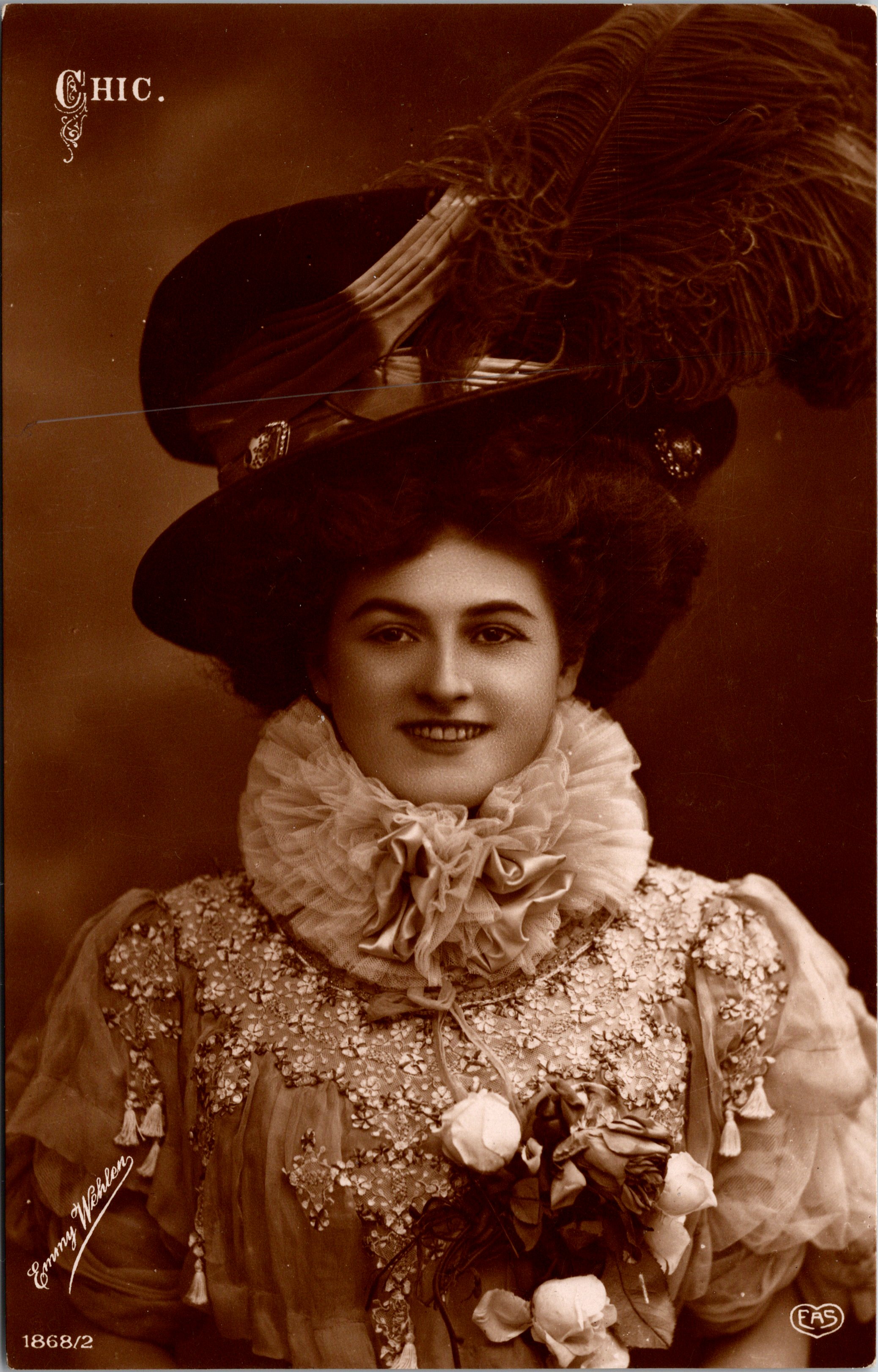
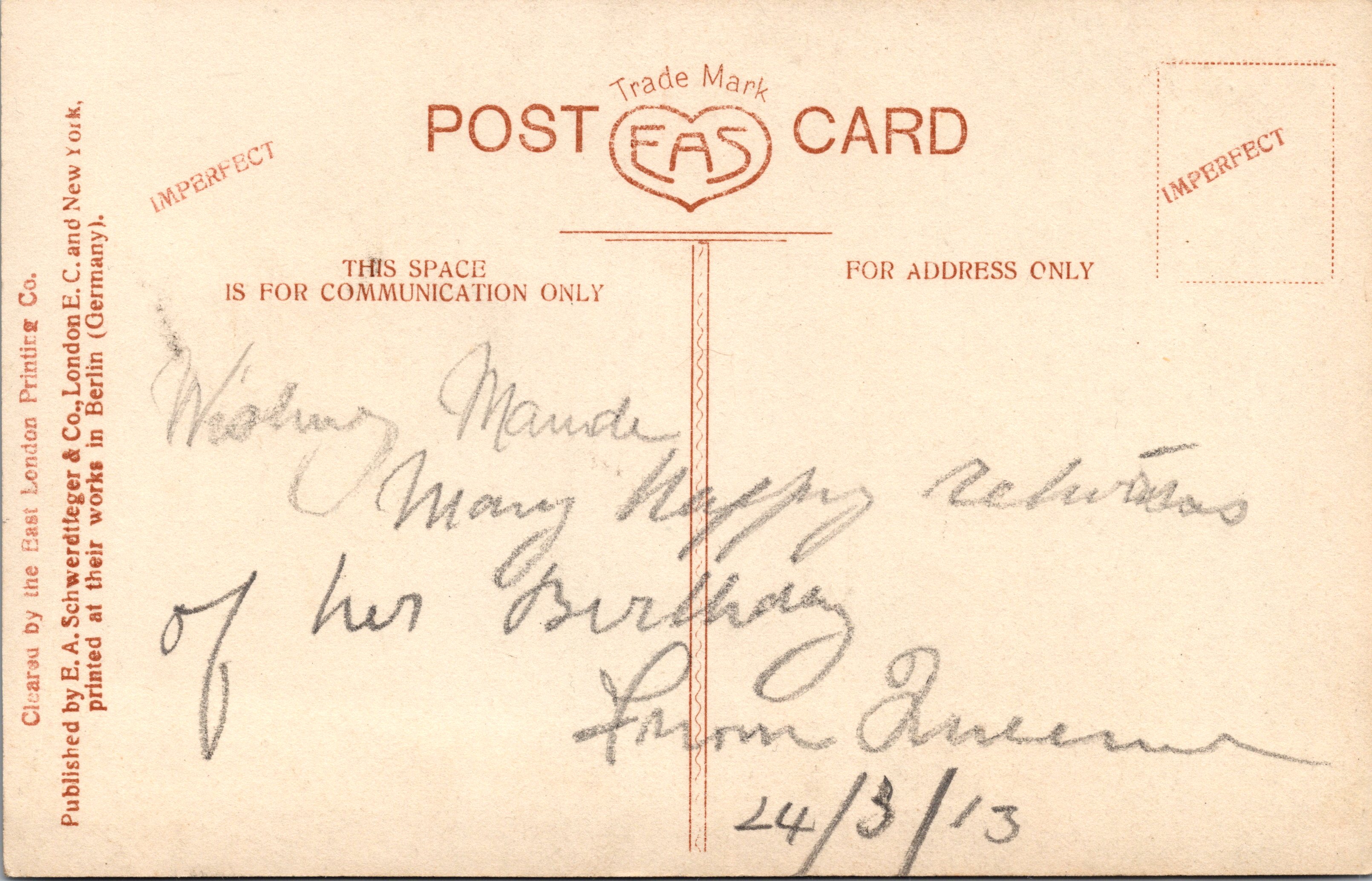
In Postcard 2, Wehlen is beautifully dressed for the portrait appearing on the postcard. She looks a bit clownish with her ruffled collar. There are flowers pinned to the front of her dress and she is wearing a jumbo feathered hat. She has a beautiful smile. The card was published by EAS as part of a series (no.1868/2). The firm was located in London and New York. The postcard was printed in Germany. Interestingly, the word “imperfect” is printed in two places on the front of the card. The word “chic” appears in the upper right hand corner of the image. Emmy Wehlen fits the bill. She is truly chic. The message on the postcard indicates that it was written in 1913. (SOLD)
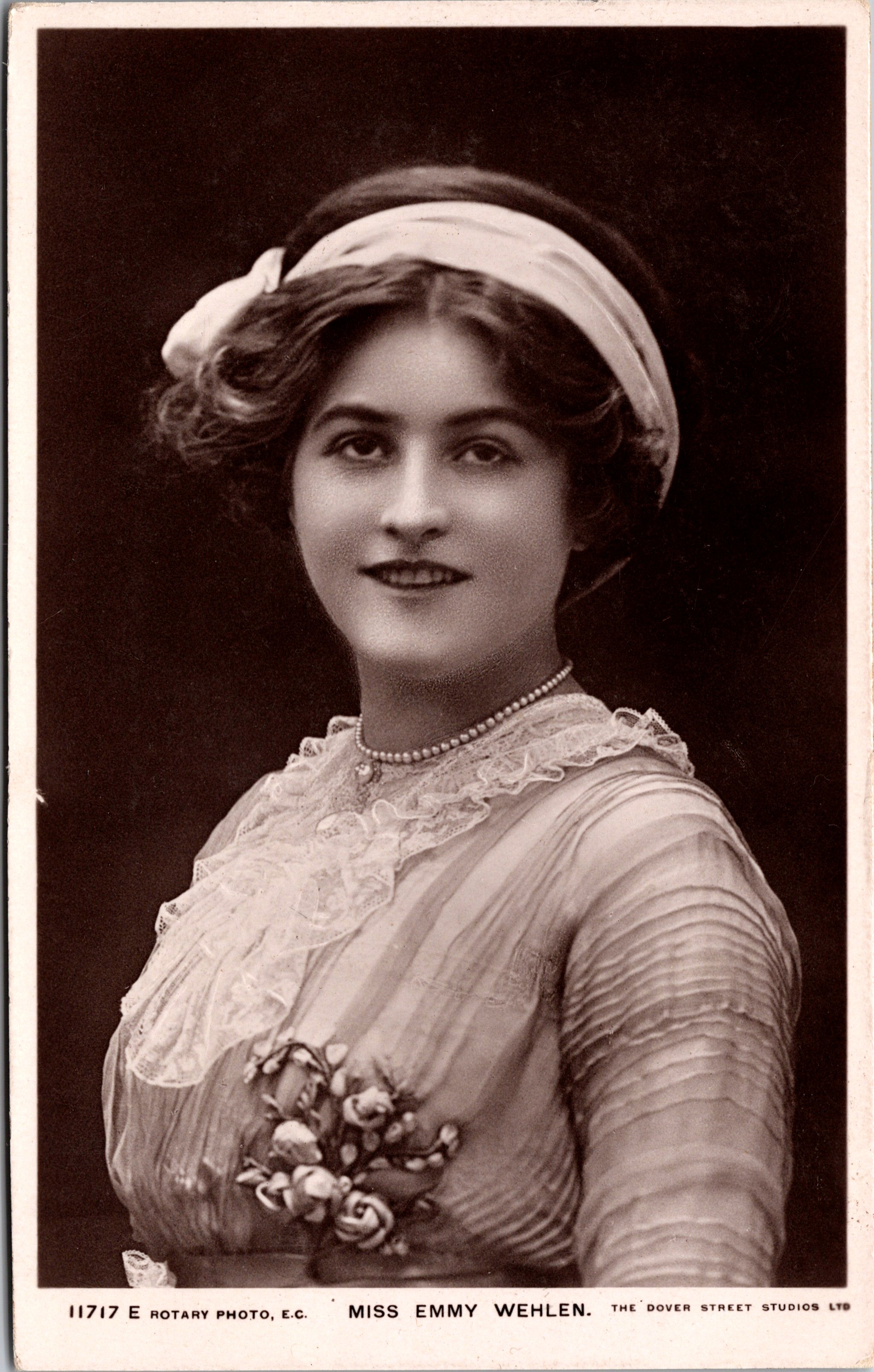
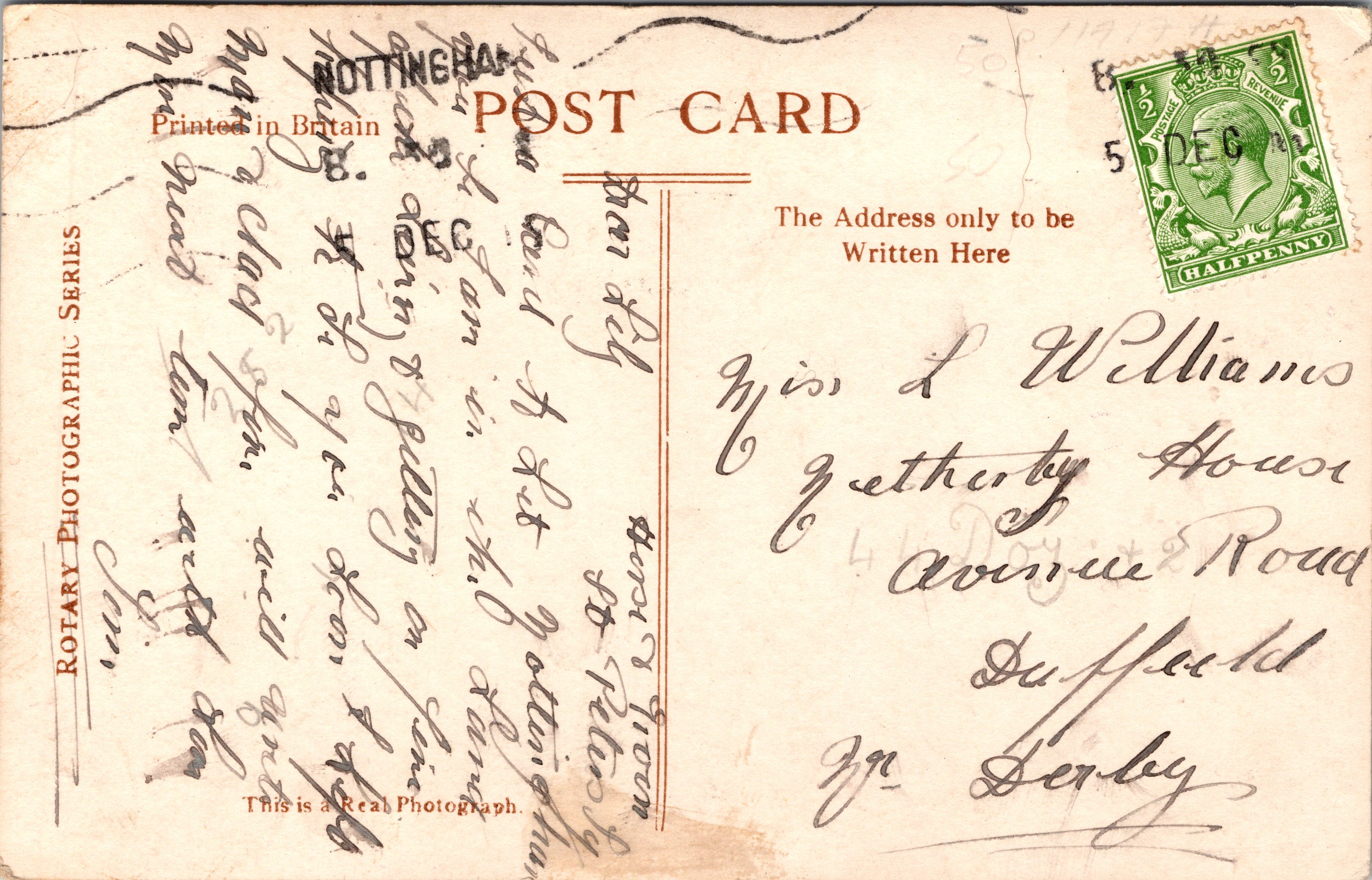
Postcard 3 features Miss Wehlen’s photograph taken by celebrity studio, Dover Street Studios. The card was published by Rotary Photo as part of a series (no.11717E). The message on the card indicates that the sender hoped that this photo postcard was meant to be an addition to the recipient’s postcard collection. (SOLD)
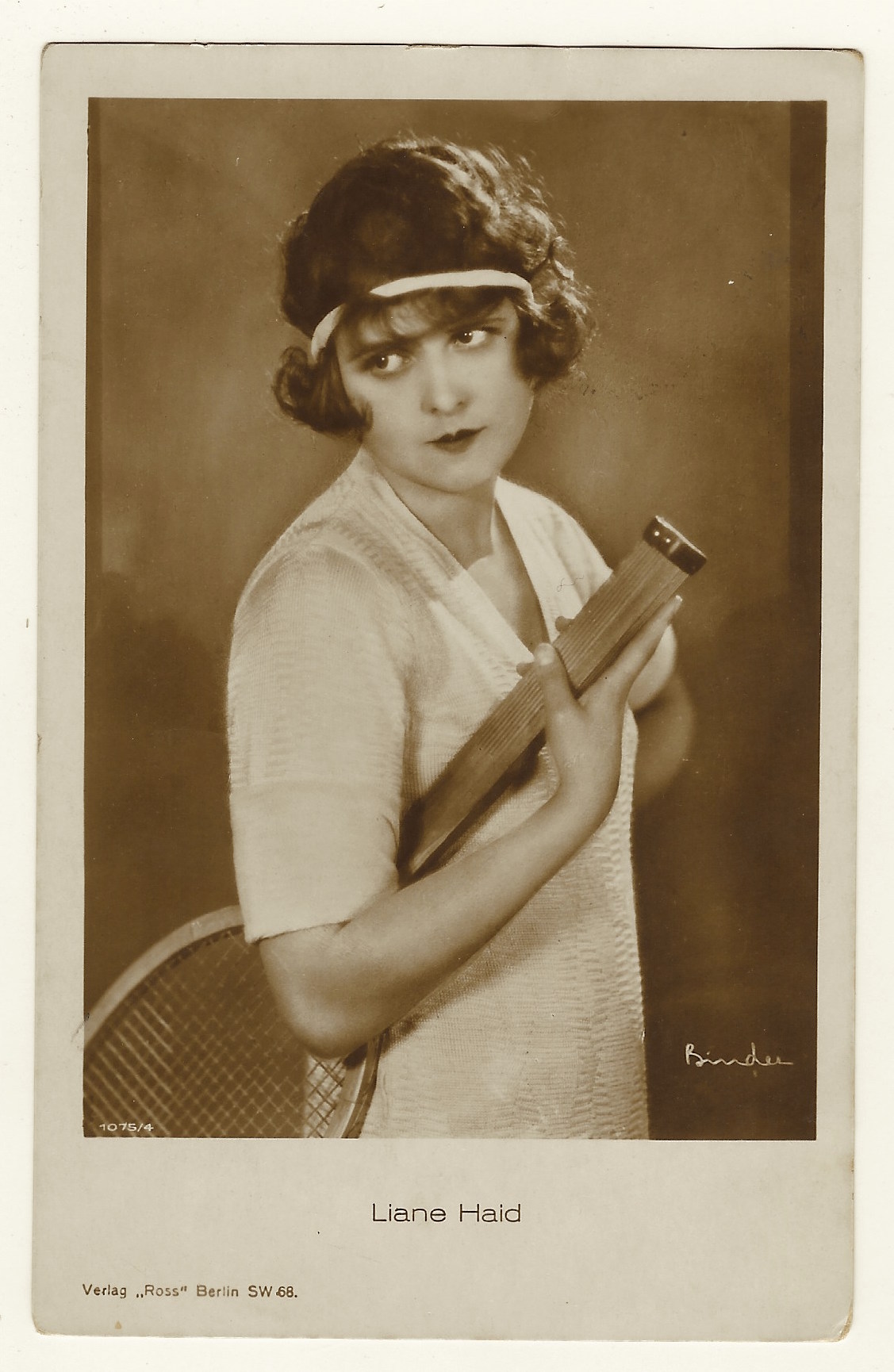
These vintage real photo postcards feature European film star Liane Haid (1895-2000). In the top postcard she poses holding a tennis racket and wearing a hair band to keep her hair out of her eyes. She is quite beautiful but how can we interpret her facial expression. To me, it looks like she is rolling her eyes as if she is bothered by something. Who is Liane Haid? She was born in Vienna, Austria and received training in both dance and singing. She gained the nickname of “Sweet Viennese Girl”. Haid was a prima ballerina, dancer, singer and stage actress. She worked in Budapest and Vienna as a dancer. Her stage career was mostly in Berlin and Vienna. She became a popular pin-up star through the 1920’s and 1930’s. Her first movie role was in a World War I propaganda film. She was employed by UFA and appeared in a number of comedy films alongside other movie stars including Willi Forst, Bruno Kastner, and Georg Alexander. UFA was a major German Film producer and distributor that operated between 1917 through the end of World War II. Liane Haid refused a number of Hollywood offers but in 1942, she escaped Nazi Germany and went to Switzerland according to Wikipedia, “because of the regime, because everything was bombed, and because all the good directors had left”. Soon thereafter she got married and retired from films. She was married three times. The IMDB web site states that she has 92 film credits from 1915 through 1953. Notable films include “Lady Hamilton” (1921), “Lucrezia Borgia” (1926), and “The Song is Ended” (1930). The photographer of this terrific image was Alexander Binder (1888-1929). He had the largest photo studio in Europe during the late 1920’s and the 1930’s. Many of his entertainment star portraits appear on Ross Verlag postards. It is thought that Binder was of Swiss origin. He was of the Jewish faith. He studied engineering but did not complete his studies. From 1908 to 1910 he studied photography at a school in Munich, Germany. After the completion of his photography studies, he went to Berlin and in 1913 opened his first photography studio. Before long, he became one of the premier photographers in Berlin. He primarily focussed on fashion and celebrity photography. Since Berlin was the capital of the European film industry, Binder photographed all the stars of the European film industry including, Lilian Harvey, Conrad Veidt, and Lya De Putti. Many of his images were used in popular film portrait postcards. His photographs could be seen in postcards published by Ross Verlag and Photochemie. Binder died in 1929 but new photo cards bearing his signature continued to be published until 1937. It is thought that the real photographer of these new postcards was Hubs Floeter (1910-1974) who was employed at the studio as an operator. The studio continued to be owned by Binder’s widow, Mrs. Binder Alleman and their two daughters. The studio was managed by the Jewish Elisabeth Baroness Vonhedlis Stengel who was later deported to the Theresienstadt concentration camp. In 1938 the Nazi’s closed Binder’s studio and it was later taken over by an Aryan photographer, Karl Ludwig Haenchen . Haenchen continued to produce celebrity portraits for postcards. His publishers included Film-Foto-Verlag. After World War II the studio was taken over by the Hasse und Wiese company.
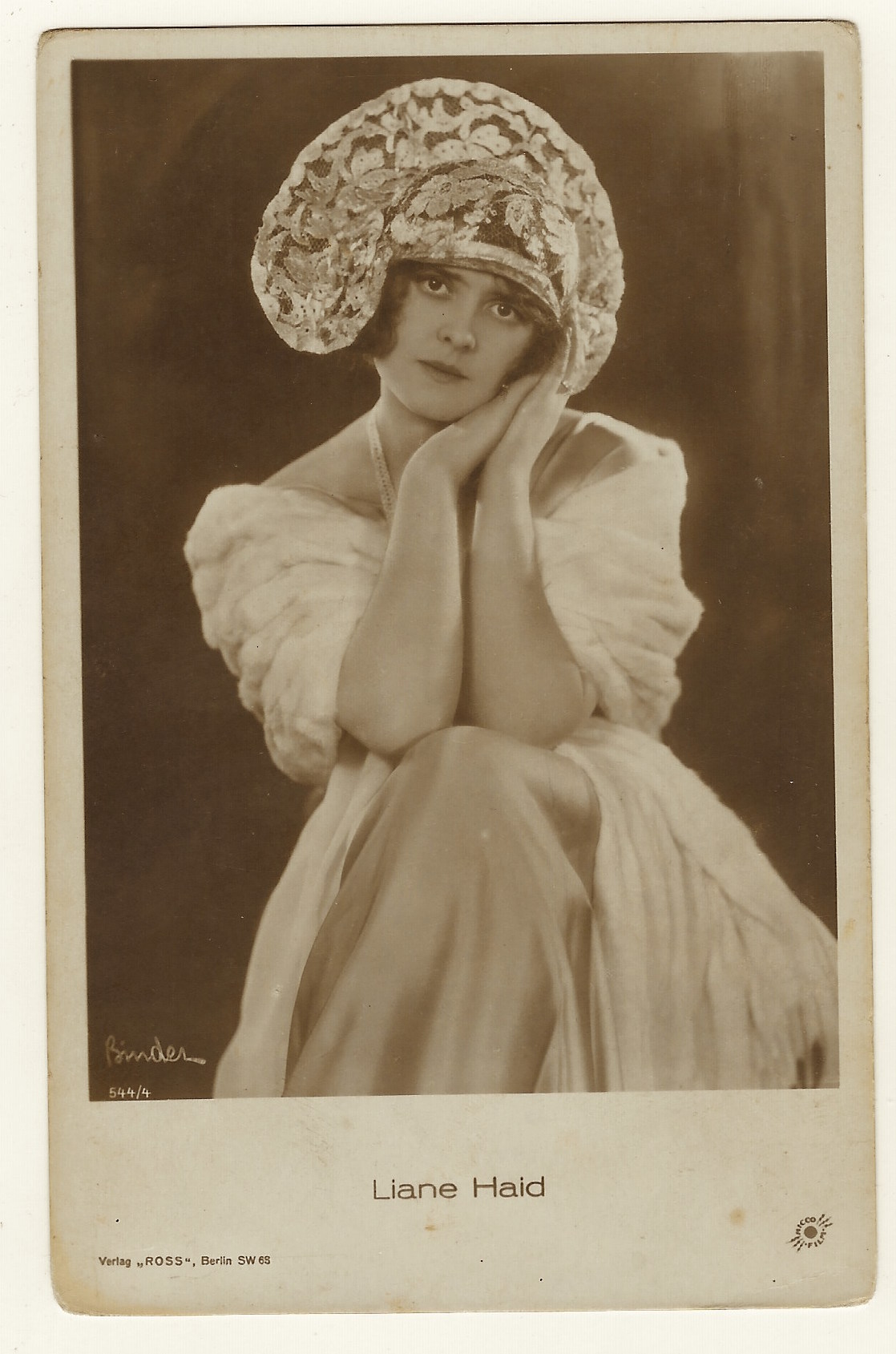
The second vintage postcard portrait of Miss Haid was also the work of Alexander Binder. The actress looks beautiful in her art deco lace headdress. Her eyes can be described as spell binding. The postcard was published by Germany’s Ross Verlag and is part of a series (no. 544/4). Also credited for this photograph is “Micco Film”. Before working for Micco Film, Haid was employed by Kunstfilm. She was very successful working for the company but in 1920 she sued the company for physically exploiting her (placing her in dangerous situations) and for making her financially responsible for her own makeup and costuming. Haid’s husband, industrialist Fritz von Haymerle, built her a studio (Micco-Film) in Vienna to further promote her career.
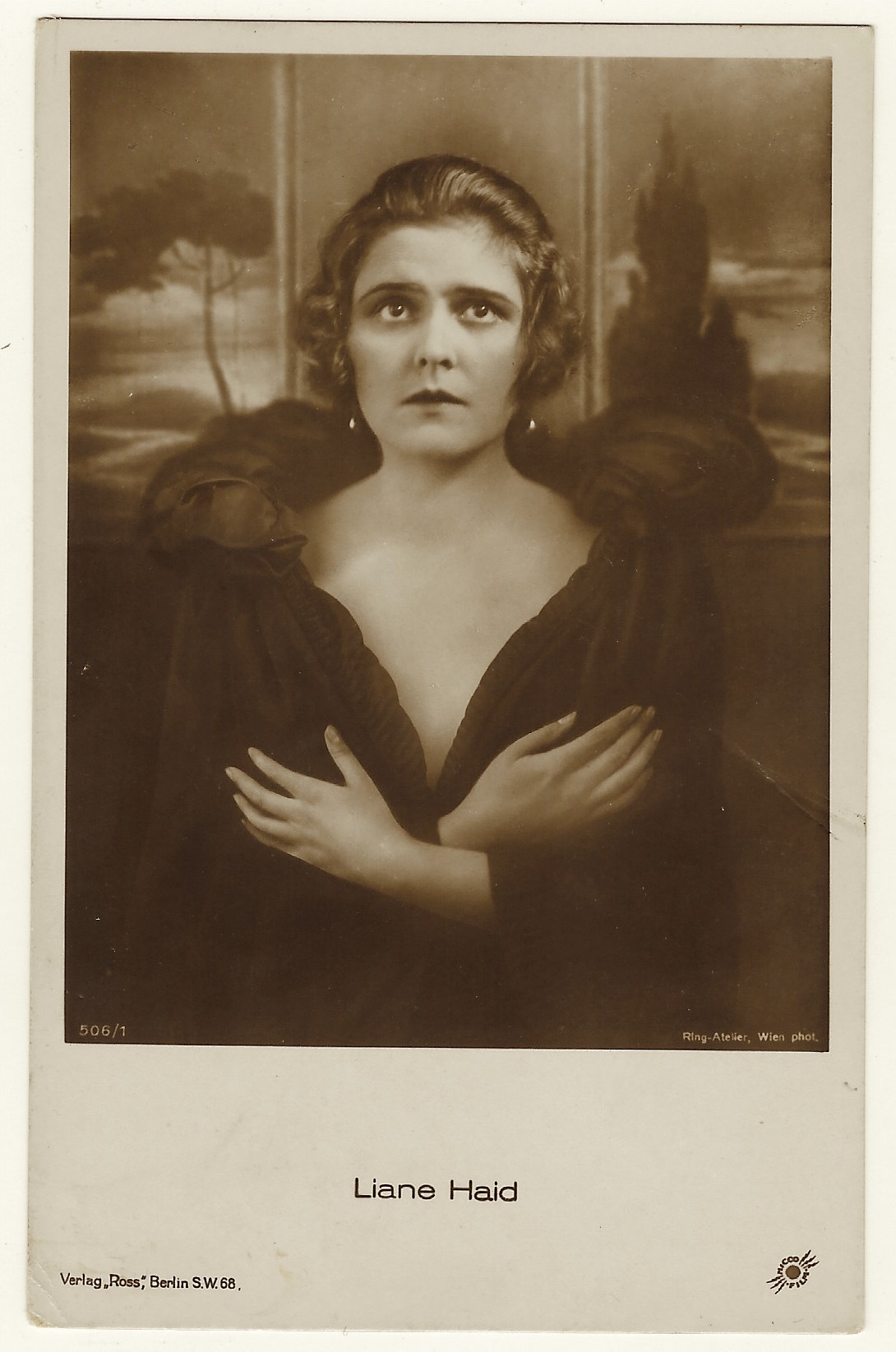
The third real photo postcard, seen above, was produced by publisher Ross Verlag (Berlin). Once again, Liane Haid appears beautiful in her portrait. The photograph was taken by the Ring studio in Vienna, Austria. A logo for Micco-Film appears in the lower right hand corner of the postcard. SOLD
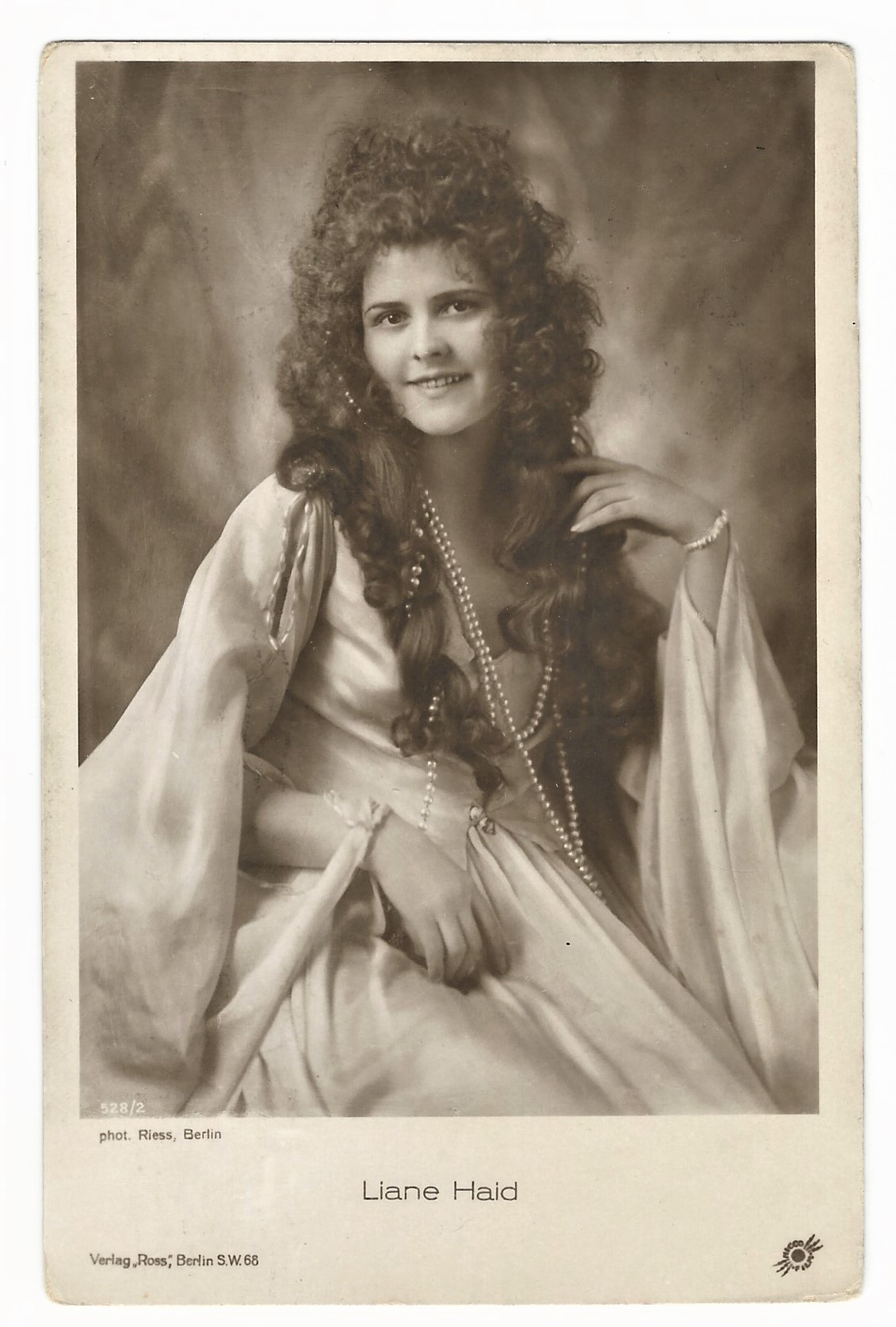
Postcard 4 is a vintage real photo postcard featuring a young and long haired Liane Haid. She is flashing a very sweet smile. The postcard was published by Ross Verlag of Berlin, Germany. It is part of a series (No. 528/2). Miss Haid was photographed by Frieda Riess (1890-1955?), a female Berlin photographer. One of her photographs can be found in Great Britain’s National Portrait Gallery. The postcard has the logo for Micco-Film in the bottom right hand corner and is postmarked 1929. The card was mailed from Denmark to Estonia. SOLD
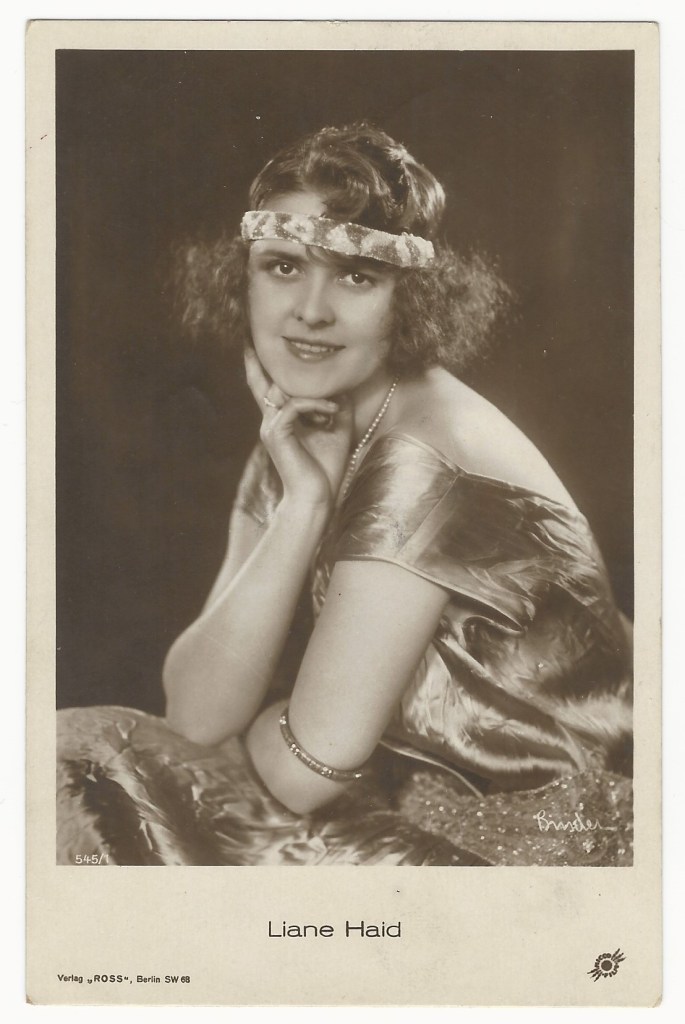
Postcard 5 features a vintage real photo of Miss Haid. As usual, she looks quite pretty. The actress is flashing a lovely smile. She is wearing a string of pearls and a hair band.This photograph was taken by the talented and prolific celebrity photographer, Alexander Binder. The postcard was published by Ross Verlag (Berlin) as part of a series (no. 545/1). The logo for Micco-Film can be seen on the bottom right hand corner of the postcard. The card was postmarked in 1925 and is in very good condition (see scans).
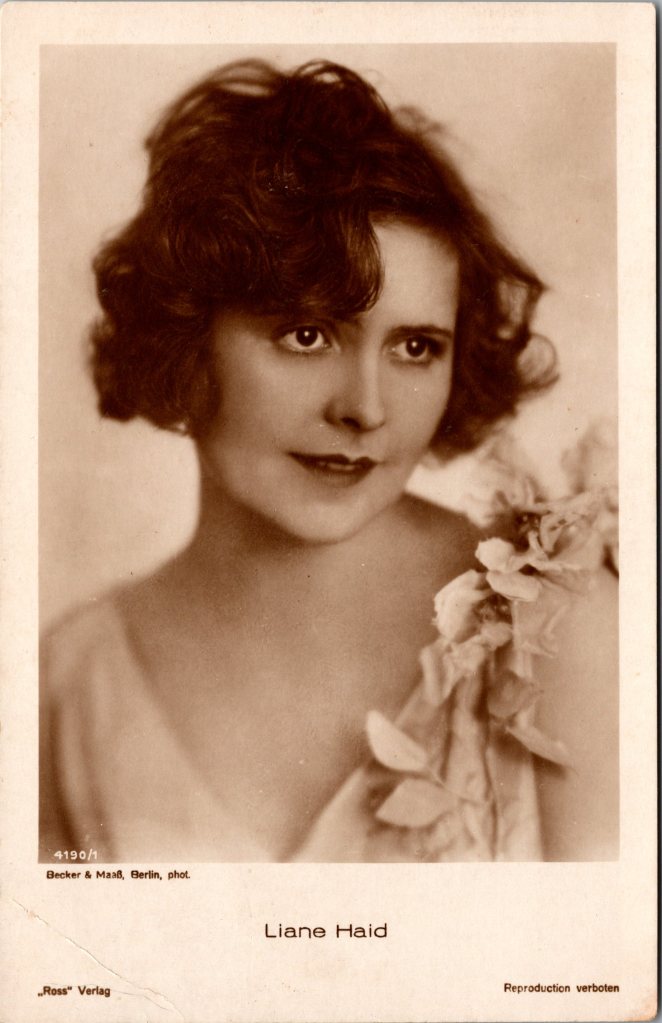
Postcard 6 offers another view of Miss Haid. She looks beautiful as always. This photograph was taken by the Becker & Maas studio. The firm was located in Berlin Germany. The publisher of the card was Ross Verlag. The postcard is part of a series (No.4190/1). (SOLD)
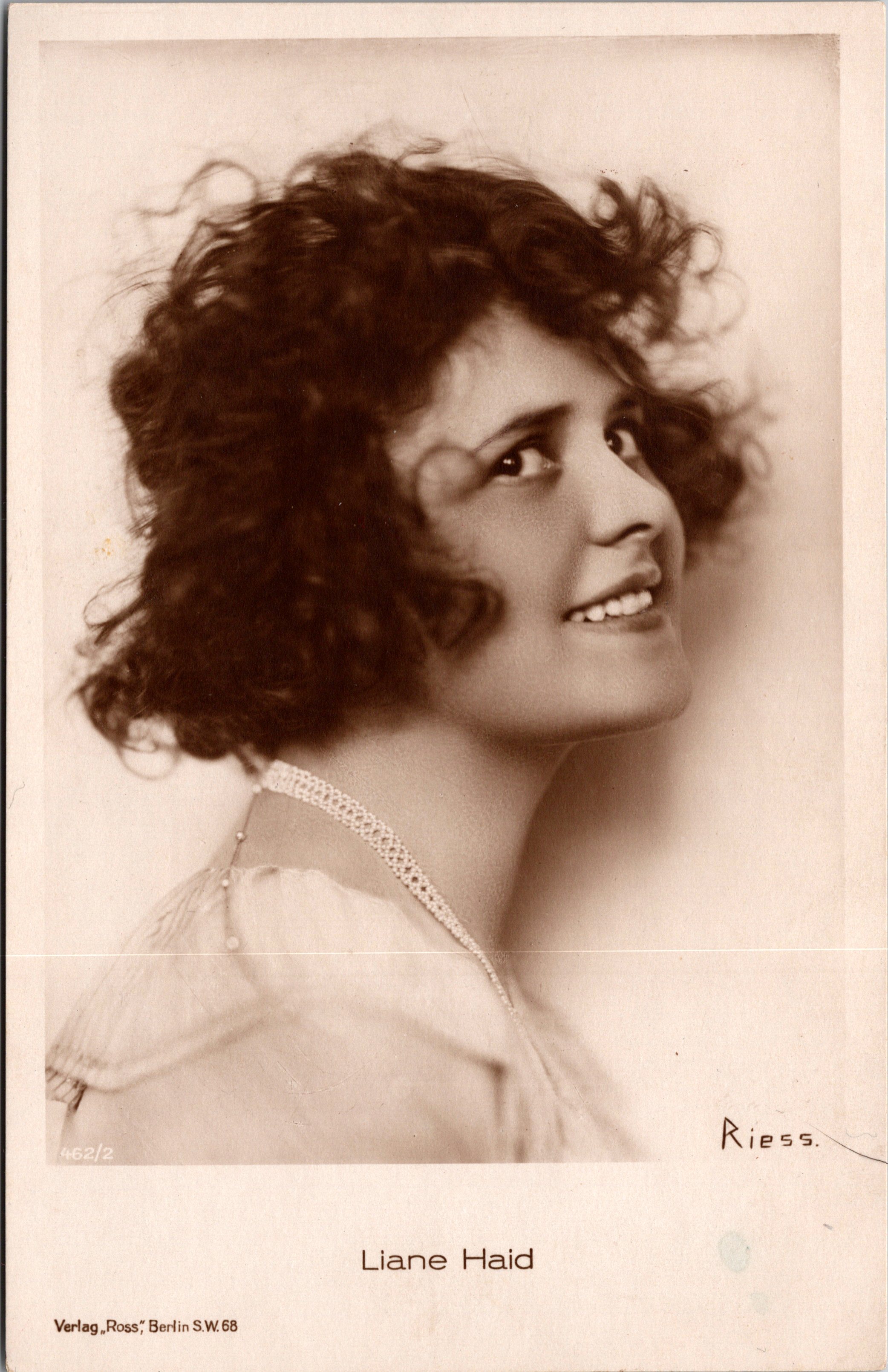
Postcard 7 features Miss Haid as photographed by Frieda Riess (1890-1955?), a female photographer located in Berlin, Germany. The publisher of the card was Ross Verlag. The postcard is part of a series (No.462/2). (SOLD)
Postcard 8 was published by Ross Verlag. The postcard is part of a series (No.1732/3). Note the logo for UFA, a German film company. (SOLD)
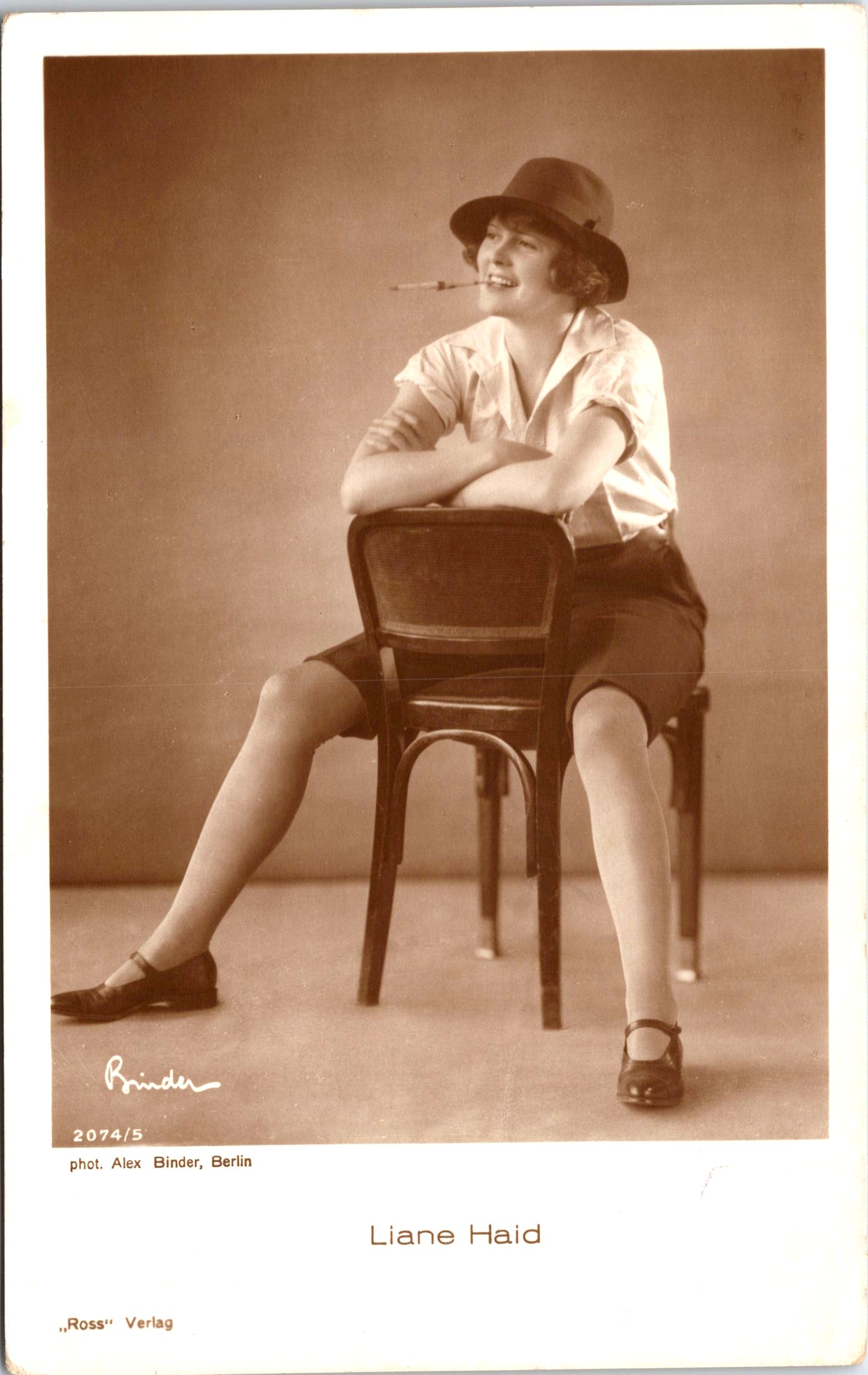
Postcard 9 features Haid sitting in a chair in a provocative manner and smoking a cigarette in a cigarette holder. This photograph portrays Haid as unconventional and seductive. The publisher of the card was Ross Verlag. The postcard is part of a series (No.2074/5). Miss Haid’s photograph appearing on this postcard was taken by Alexander Binder (Berlin, Germany). (SOLD)







 THE CABINET CARD GALLERY